Hygrine: Difference between revisions
CSV import |
CSV import Tags: mobile edit mobile web edit |
||
| (2 intermediate revisions by the same user not shown) | |||
| Line 1: | Line 1: | ||
{{ | {{Short description|Chemical compound}} | ||
'''Hygrine''' is a [[pyrrolidine]] [[alkaloid]] found in the leaves of the [[coca plant]] (''[[Erythroxylum coca]]''). It was first isolated by the German chemist [[Carl Liebermann]] in 1889. Hygrine is one of the many [[alkaloids]] present in coca leaves, although it is not the primary active compound responsible for the [[stimulant]] effects of [[cocaine]]. | |||
== Chemical Structure and Properties == | |||
Hygrine is a [[ketone]] with a [[pyrrolidine]] ring, which is a five-membered [[heterocyclic]] [[amine]]. The chemical formula of hygrine is C<sub>8</sub>H<sub>15</sub>NO, and it has a [[molar mass]] of 141.21 g/mol. The structure consists of a [[pyrrolidine]] ring attached to a [[propanone]] group. | |||
== | == Occurrence and Isolation == | ||
Hygrine is | Hygrine is naturally occurring in the leaves of the [[coca plant]], which is native to [[South America]]. The isolation of hygrine from coca leaves involves the extraction of the [[alkaloid]] fraction, followed by purification processes such as [[chromatography]]. | ||
== | == Biological Activity == | ||
While hygrine itself does not have significant [[pharmacological]] activity, it is often studied in conjunction with other [[alkaloids]] found in coca leaves. The primary interest in hygrine is due to its presence in the [[coca plant]] and its potential role in the [[biosynthesis]] of other [[alkaloids]]. | |||
== | == See Also == | ||
* [[Cocaine]] | * [[Cocaine]] | ||
* [[Pyrrolidine]] | * [[Pyrrolidine]] | ||
* [[Alkaloid]] | * [[Alkaloid]] | ||
* [[ | * [[Erythroxylum coca]] | ||
== External Links == | |||
* [https://pubchem.ncbi.nlm.nih.gov/compound/Hygrine Hygrine on PubChem] | |||
[[Category:Alkaloids]] | [[Category:Alkaloids]] | ||
[[Category:Pyrrolidines]] | [[Category:Pyrrolidines]] | ||
[[Category:Ketones]] | |||
[[Category:Coca plant]] | [[Category:Coca plant]] | ||
<gallery> | |||
File:Hygrine Structural Formula V.1.svg|Hygrine Structural Formula V.1 | |||
File:Hygrine ball-and-stick.png|Hygrine ball-and-stick | |||
</gallery> | |||
Latest revision as of 06:04, 3 March 2025
Chemical compound
Hygrine is a pyrrolidine alkaloid found in the leaves of the coca plant (Erythroxylum coca). It was first isolated by the German chemist Carl Liebermann in 1889. Hygrine is one of the many alkaloids present in coca leaves, although it is not the primary active compound responsible for the stimulant effects of cocaine.
Chemical Structure and Properties[edit]
Hygrine is a ketone with a pyrrolidine ring, which is a five-membered heterocyclic amine. The chemical formula of hygrine is C8H15NO, and it has a molar mass of 141.21 g/mol. The structure consists of a pyrrolidine ring attached to a propanone group.
Occurrence and Isolation[edit]
Hygrine is naturally occurring in the leaves of the coca plant, which is native to South America. The isolation of hygrine from coca leaves involves the extraction of the alkaloid fraction, followed by purification processes such as chromatography.
Biological Activity[edit]
While hygrine itself does not have significant pharmacological activity, it is often studied in conjunction with other alkaloids found in coca leaves. The primary interest in hygrine is due to its presence in the coca plant and its potential role in the biosynthesis of other alkaloids.
See Also[edit]
External Links[edit]
-
 Hygrine Structural Formula V.1
 -
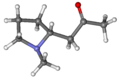 Hygrine ball-and-stick


