Tempura: Difference between revisions
CSV import |
CSV import |
||
| Line 47: | Line 47: | ||
[[Category:Seafood dishes]] | [[Category:Seafood dishes]] | ||
[[Category:Vegetable dishes]] | [[Category:Vegetable dishes]] | ||
<gallery> | |||
File:Tempura 01.jpg|Tempura | |||
File:つな八 盛り付け (25086067202).jpg|Tempura | |||
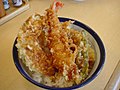
File:Tendon.jpg|Tempura | |||
File:Shinshu soba, ten zaru by hirotomo in Suwa, Nagano.jpg|Tempura | |||
File:Udon-M1336.jpg|Tempura | |||
File:Frying tempura 2014.jpg|Tempura | |||
File:Scallop with Sea Urchin - Tempura Hajime - South Melbourne, Victoria, Australia.jpg|Tempura | |||
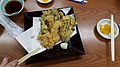
File:Mushroom tempura (1841913668).jpg|Tempura | |||
File:Veg tempura asakusa.jpg|Tempura | |||
File:Tempura and tentsuyu by cathykid in Taipei.jpg|Tempura | |||
File:大洗マリンタワーかき揚げ丼.jpg|Tempura | |||
File:Peixinhos da horta.jpg|Tempura | |||
</gallery> | |||
Latest revision as of 01:28, 20 February 2025
.jpg)


Tempura is a traditional Japanese dish consisting of seafood or vegetables that have been battered and deep-fried. The dish is known for its light and crispy texture, which is achieved by using a batter made from cold water, flour, and sometimes eggs. Tempura is often served with a dipping sauce called tentsuyu, which is made from dashi, mirin, and soy sauce.
History[edit]
Tempura was introduced to Japan by Portuguese missionaries and traders in the 16th century. The word "tempura" is derived from the Latin word "tempora," which refers to the Ember Days, during which Catholics refrain from eating meat. The Japanese adapted the dish, using local ingredients and techniques, to create the tempura we know today.
Ingredients[edit]
The primary ingredients for tempura include:
- Seafood: Common choices are shrimp, squid, and white fish.
- Vegetables: Popular options include sweet potatoes, eggplant, bell peppers, and mushrooms.
- Batter: Made from cold water, flour, and sometimes eggs.
Preparation[edit]
The preparation of tempura involves several steps: 1. Preparation of Ingredients: Seafood and vegetables are cleaned, cut, and dried. 2. Making the Batter: The batter is prepared using cold water and flour, and sometimes eggs. The batter should be mixed lightly to avoid activating the gluten in the flour, which can make the tempura heavy. 3. Frying: The ingredients are dipped in the batter and then deep-fried in hot oil until they are golden and crispy.
Serving[edit]
Tempura is typically served with a dipping sauce called tentsuyu, which is made from dashi, mirin, and soy sauce. It is often accompanied by grated daikon radish and ginger. Tempura can also be served over a bowl of rice, known as tendon, or over noodles, known as tempura soba or tempura udon.
Variations[edit]
There are several variations of tempura, including:
- Ebi Tempura: Shrimp tempura, one of the most popular types.
- Kakiage: A type of tempura made with a mixture of chopped vegetables and seafood.
- Tempura Donburi: Tempura served over rice, also known as tendon.
Related Pages[edit]
See Also[edit]
| Japanese cuisine 日本料理 |
|---|
|
|

-
 Tempura
 -
 Tempura
 -
 Tempura
 -
 Tempura
 -
 Tempura
 -
 Tempura
 -
 Tempura
 -
 Tempura
 -
 Tempura
 -
 Tempura
 -
 Tempura
 -
 Tempura

.jpg)


