Areni-1 winery: Difference between revisions
mNo edit summary |
CSV import Tags: mobile edit mobile web edit |
||
| (One intermediate revision by the same user not shown) | |||
| Line 1: | Line 1: | ||
{{ | {{short description|Region of Italy}} | ||
{{Use dmy dates|date=October 2023}} | |||
| | |||
| | |||
}} | |||
The ''' | The '''Aosta Valley''' (Italian: ''Valle d'Aosta'', French: ''Vallée d'Aoste'') is a mountainous autonomous region in northwestern [[Italy]]. It is bordered by [[France]] to the west, [[Switzerland]] to the north, and the Italian region of [[Piedmont]] to the south and east. The region is known for its stunning alpine landscapes, rich history, and cultural heritage. | ||
== | ==Geography== | ||
The | The Aosta Valley is the smallest and least populous region of Italy. It is situated in the heart of the [[Alps]], surrounded by some of the highest peaks in Europe, including [[Mont Blanc]] (Monte Bianco), [[Monte Rosa]], and the [[Matterhorn]] (Cervino). The region is characterized by its rugged terrain, deep valleys, and numerous glaciers. | ||
The | ===Mountains=== | ||
The Aosta Valley is home to several prominent mountain ranges, including the [[Graian Alps]] and the [[Pennine Alps]]. The highest point in the region is Mont Blanc, which stands at 4,808 meters (15,774 feet) and is the highest mountain in Western Europe. | |||
== | ===Lakes and Rivers=== | ||
The | The region is also dotted with beautiful alpine lakes, such as [[Lago Blu]], and is traversed by the [[Dora Baltea]] river, which flows through the valley from north to south. | ||
==History== | |||
The Aosta Valley has a rich history that dates back to ancient times. It was originally inhabited by the [[Salassi]], a Celtic tribe, before being conquered by the [[Roman Empire]] in 25 BC. The Romans founded the city of [[Aosta]], which became an important military and commercial center. | |||
== | ===Medieval Period=== | ||
During the medieval period, the region was part of the Kingdom of [[Burgundy]] and later came under the control of the [[House of Savoy]]. Numerous castles and fortresses, such as the [[Fort of Bard]] and [[Castello di Fénis]], were built during this time to defend the territory. | |||
===Modern Era=== | |||
In the 20th century, the Aosta Valley gained autonomy and became a special autonomous region of Italy in 1948. This status allows the region to preserve its unique cultural and linguistic heritage. | |||
== | ==Culture== | ||
The Aosta Valley is a bilingual region, with both Italian and French as official languages. The local population also speaks a dialect known as [[Valdôtain]], which is a variety of Franco-Provençal. | |||
== | ===Cuisine=== | ||
The region is known for its traditional cuisine, which includes dishes such as [[fondue]], [[polenta]], and [[fontina]] cheese. Fontina is a key ingredient in many local recipes and is protected by a [[DOP]] (Denominazione di Origine Protetta) designation. | |||
[[ | ===Festivals=== | ||
[[ | The Aosta Valley hosts several cultural festivals throughout the year, celebrating its rich traditions and heritage. These include the [[Sant'Orso Fair]], which showcases local crafts and products. | ||
[[Category: | |||
==Tourism== | |||
Tourism is a major industry in the Aosta Valley, attracting visitors with its ski resorts, hiking trails, and historical sites. Popular destinations include the [[Gran Paradiso National Park]], the [[Skyway Monte Bianco]], and the ancient [[Roman Theatre of Aosta]]. | |||
==Related pages== | |||
* [[Mont Blanc]] | |||
* [[Gran Paradiso National Park]] | |||
* [[House of Savoy]] | |||
* [[Roman Theatre of Aosta]] | |||
==Gallery== | |||
<gallery> | |||
Monte_Bianco_DSF1243-m.jpg|Mont Blanc | |||
Lago_Blu_2.jpg|Lago Blu | |||
Aosta_Teatro_romano_03.jpg|Roman Theatre of Aosta | |||
Aoste_tour_des_seigneurs_de_quart.jpg|Tour des Seigneurs de Quart | |||
Valle_d'Aosta_map_it.jpg|Map of Aosta Valley | |||
ForteDiBardHoneAug052023_02.jpg|Fort of Bard | |||
Casa_Valdostana_Cretaz_Valtournenche.JPG|Traditional Valdostan house | |||
Cime_Bianche.JPG|Cime Bianche | |||
FontainemoreAugust192023_01.jpg|Fontainemore | |||
Panneaux_Chambarlet_Aoste.jpg|Chambarlet panels | |||
CastelloDiSaintPierreJuly312023_03.jpg|Castle of Saint-Pierre | |||
A08.M01.ValDAosta03.jpg|Val d'Aosta landscape | |||
CastelloDiVerresJuly292023_04.jpg|Castle of Verrès | |||
IssogneJuly292023_01.jpg|Issogne Castle | |||
Castello_di_Bard,_infinito.jpg|Castle of Bard | |||
CastelloSavoiaAugust192023_01.jpg|Castle Savoia | |||
CastelloDiAymavillesJuly312023_02.jpg|Castle of Aymavilles | |||
Villeneuve_Chatel_Argent_01.jpg|Châtel-Argent | |||
Fontina_DOP.jpg|Fontina cheese | |||
Fort_of_Bard.JPG|Fort of Bard | |||
Verrès_(AO)_-_ponte_ferroviario_sulla_Dora_Baltea.jpg|Railway bridge over Dora Baltea | |||
Sito_archeologico_di_Chenal_1120484.JPG|Archaeological site of Chenal | |||
La_Thuile-Rifugio_Deffeyes_2.jpg|Rifugio Deffeyes | |||
Capra_ibex_gran_paradiso.jpg|Ibex in Gran Paradiso | |||
Marmotta_alpina_(Marmota_marmota).jpg|Alpine marmot | |||
</gallery> | |||
[[Category:Aosta Valley]] | |||
<gallery> | |||
File:Areni-1_cave_entrance.jpg|Entrance to the Areni-1 cave | |||
File:Areni-1_cave_panorama.jpg|Panoramic view of the Areni-1 cave | |||
File:5-Hydroxy-L-Tryptophan_(5-HTP).svg|Chemical structure of 5-Hydroxy-L-Tryptophan (5-HTP) | |||
</gallery> | |||
Latest revision as of 00:54, 18 February 2025
Region of Italy
The Aosta Valley (Italian: Valle d'Aosta, French: Vallée d'Aoste) is a mountainous autonomous region in northwestern Italy. It is bordered by France to the west, Switzerland to the north, and the Italian region of Piedmont to the south and east. The region is known for its stunning alpine landscapes, rich history, and cultural heritage.
Geography[edit]
The Aosta Valley is the smallest and least populous region of Italy. It is situated in the heart of the Alps, surrounded by some of the highest peaks in Europe, including Mont Blanc (Monte Bianco), Monte Rosa, and the Matterhorn (Cervino). The region is characterized by its rugged terrain, deep valleys, and numerous glaciers.
Mountains[edit]
The Aosta Valley is home to several prominent mountain ranges, including the Graian Alps and the Pennine Alps. The highest point in the region is Mont Blanc, which stands at 4,808 meters (15,774 feet) and is the highest mountain in Western Europe.
Lakes and Rivers[edit]
The region is also dotted with beautiful alpine lakes, such as Lago Blu, and is traversed by the Dora Baltea river, which flows through the valley from north to south.
History[edit]
The Aosta Valley has a rich history that dates back to ancient times. It was originally inhabited by the Salassi, a Celtic tribe, before being conquered by the Roman Empire in 25 BC. The Romans founded the city of Aosta, which became an important military and commercial center.
Medieval Period[edit]
During the medieval period, the region was part of the Kingdom of Burgundy and later came under the control of the House of Savoy. Numerous castles and fortresses, such as the Fort of Bard and Castello di Fénis, were built during this time to defend the territory.
Modern Era[edit]
In the 20th century, the Aosta Valley gained autonomy and became a special autonomous region of Italy in 1948. This status allows the region to preserve its unique cultural and linguistic heritage.
Culture[edit]
The Aosta Valley is a bilingual region, with both Italian and French as official languages. The local population also speaks a dialect known as Valdôtain, which is a variety of Franco-Provençal.
Cuisine[edit]
The region is known for its traditional cuisine, which includes dishes such as fondue, polenta, and fontina cheese. Fontina is a key ingredient in many local recipes and is protected by a DOP (Denominazione di Origine Protetta) designation.
Festivals[edit]
The Aosta Valley hosts several cultural festivals throughout the year, celebrating its rich traditions and heritage. These include the Sant'Orso Fair, which showcases local crafts and products.
Tourism[edit]
Tourism is a major industry in the Aosta Valley, attracting visitors with its ski resorts, hiking trails, and historical sites. Popular destinations include the Gran Paradiso National Park, the Skyway Monte Bianco, and the ancient Roman Theatre of Aosta.
Related pages[edit]
Gallery[edit]
-
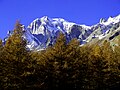 Mont Blanc
 -
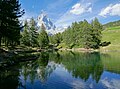 Lago Blu
 -
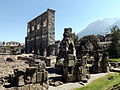 Roman Theatre of Aosta
 -
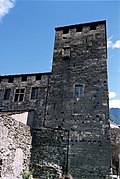 Tour des Seigneurs de Quart
 -
Map of Aosta Valley
-
Fort of Bard
-
Traditional Valdostan house
-
Cime Bianche
-
Fontainemore
-
Chambarlet panels
-
Castle of Saint-Pierre
-
Val d'Aosta landscape
-
Castle of Verrès
-
Issogne Castle
-
Castle of Bard
-
Castle Savoia
-
Castle of Aymavilles
-
Châtel-Argent
-
Fontina cheese
-
Fort of Bard
-
Railway bridge over Dora Baltea
-
Archaeological site of Chenal
-
Rifugio Deffeyes
-
Ibex in Gran Paradiso
-
Alpine marmot


-
Entrance to the Areni-1 cave
-
Panoramic view of the Areni-1 cave
-
Chemical structure of 5-Hydroxy-L-Tryptophan (5-HTP)


_-_ponte_ferroviario_sulla_Dora_Baltea.jpg)


.jpg)


.svg)