Sleep in animals: Difference between revisions
CSV import Tags: mobile edit mobile web edit |
CSV import |
||
| Line 31: | Line 31: | ||
[[Category:Animal behavior]] | [[Category:Animal behavior]] | ||
{{biology-stub}} | {{biology-stub}} | ||
<gallery> | |||
File:Lion_and_lioness_sleeping.JPG|Lion and lioness sleeping | |||
File:Alopex_lagopus_IMG_9019.JPG|Arctic fox sleeping | |||
File:Enlarged_c_elegans.jpg|C. elegans | |||
File:Cuckoo_bee.jpg|Cuckoo bee | |||
File:Sleeping_Dragon_-_macro_(2841003581).jpg|Sleeping dragonfly | |||
File:Bradypodion_tavetanum_sleeping.jpg|Bradypodion tavetanum sleeping | |||
File:KomodoDragon.jpg|Komodo dragon | |||
</gallery> | |||
Latest revision as of 02:12, 27 February 2025
Sleep in Animals refers to the restorative state that is part of the daily cycle of most animal species, including all mammals, birds, and many reptiles, amphibians, and fish. Sleep is characterized by altered consciousness, reduced sensory activity, and inhibition of nearly all voluntary muscles. It is distinguished from wakefulness by a decreased ability to react to stimuli. The specifics of sleep vary widely among different species, reflecting evolutionary adaptations to diverse environments and lifestyles.
Types of Sleep[edit]
Sleep in animals can generally be divided into two types: REM sleep (Rapid Eye Movement sleep) and non-REM sleep. REM sleep is associated with dreaming and brain activity similar to wakefulness, and is thought to play a role in the processing of memory and emotional health. Non-REM sleep, which has several stages, is considered a deeper, more restorative form of sleep.
REM Sleep[edit]
In mammals and birds, REM sleep is characterized by rapid movement of the eyes, low muscle tone, and vivid dreams. The function of REM sleep is not fully understood, but it is believed to be important for brain development in infants and for memory consolidation in adults.
Non-REM Sleep[edit]
Non-REM sleep is divided into stages, ranging from light sleep to deep sleep. During the deepest stages of non-REM sleep, the body repairs and regrows tissues, builds bone and muscle, and strengthens the immune system.
Sleep Regulation[edit]
The regulation of sleep involves complex interactions between various neurotransmitter systems in the brain. The circadian rhythm, an internal clock that operates on a roughly 24-hour cycle, plays a key role in determining sleep patterns. Environmental cues such as light and temperature can reset the circadian rhythm, thereby influencing sleep schedules.
Evolution of Sleep[edit]
The evolutionary origins of sleep are not fully understood, but it is believed that sleep serves several essential biological functions, including energy conservation, restoration of the brain and body, and memory consolidation. Some theories suggest that sleep evolved as a way to increase an animal's efficiency and survival by reducing its activity during times of day when it is most vulnerable to predators.
Sleep in Different Animal Species[edit]
The amount and type of sleep required varies significantly across different animal species. Some animals, like certain birds and mammals, can sleep with one half of their brain while the other half remains awake, a phenomenon known as unihemispheric slow-wave sleep. This allows them to rest while still being alert to potential threats.
Aquatic Mammals[edit]
Aquatic mammals, such as dolphins and some whales, also exhibit unihemispheric sleep, allowing them to surface for air while still maintaining some level of sleep.
Insects[edit]
Even insects exhibit sleep-like states, though these are less well understood. Studies on fruit flies have shown that they have periods of inactivity that share several characteristics with sleep, including increased arousal thresholds and a need to make up for sleep loss.
Conclusion[edit]
Sleep is a fundamental aspect of the biology of most animals, reflecting a complex interplay of evolutionary, physiological, and environmental factors. Despite the variations across species, the universal presence of sleep or sleep-like states underscores its critical role in health and survival.

-
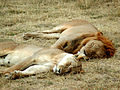 Lion and lioness sleeping
 -
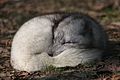 Arctic fox sleeping
 -
 C. elegans
 -
 Cuckoo bee
 -
 Sleeping dragonfly
 -
 Bradypodion tavetanum sleeping
 -
 Komodo dragon


.jpg)


