Clitocybe nebularis: Difference between revisions
CSV import |
CSV import Tags: mobile edit mobile web edit |
||
| Line 21: | Line 21: | ||
[[Category:Edible mushrooms]] | [[Category:Edible mushrooms]] | ||
{{mycology-stub}} | {{mycology-stub}} | ||
<gallery> | |||
File:Nevelzwam_(nebularis)_tussen_afgevallen_beukenblad_(d.j.b.)_01.jpg|Nevelzwam (nebularis) tussen afgevallen beukenblad | |||
File:Cluded_Agaric_pileus.JPG|Cluded Agaric pileus | |||
File:Clouded_Agaric_Gills.JPG|Clouded Agaric Gills | |||
File:Clouded_Agaric_underside.JPG|Clouded Agaric underside | |||
File:Hexenring_Nebelgrauer_Trichterling.JPG|Hexenring Nebelgrauer Trichterling | |||
File:Nevelzwam_(_nebularis)_(d.j.b.)_14-12-2023._(d.j.b).jpg|Nevelzwam (nebularis) 14-12-2023 | |||
</gallery> | |||
Latest revision as of 11:45, 25 February 2025
Clitocybe nebularis, commonly known as the clouded agaric or cloud funnel, is a species of mushroom found in both Europe and North America. Belonging to the large genus Clitocybe, it is characterized by its large, grey cap and the gregarious nature of its growth, often found in troops in woodland areas during the autumn season.
Description[edit]
Clitocybe nebularis features a large, convex cap that typically ranges from 5 to 15 cm in diameter, though specimens can grow larger. The cap is clouded grey or sometimes brownish, with a smooth surface that becomes sticky when wet. The margin of the cap is initially curved inward before flattening out with age, often becoming wavy. The gills are decurrent, running down the stem, and are crowded and white or light grey in color. The stem is robust, white to grey, and can be up to 10 cm tall and 2 cm thick, sometimes with a swollen base.
The spore print of Clitocybe nebularis is white, and its spores are smooth, ellipsoid, and measure 5.5–8 x 3–4 µm. It has a distinctive, strong smell that some find unpleasant, often described as being similar to wet flour or dough.
Habitat and Distribution[edit]
Clitocybe nebularis is widely distributed in temperate regions of Europe and North America. It prefers to grow in both deciduous and coniferous forests, thriving in moist, rich soils. It is commonly found in large groups or rings, sometimes in the same location for many years, from late summer to late autumn.
Edibility[edit]
The edibility of Clitocybe nebularis is controversial. While it is consumed in some parts of Europe, it is known to cause gastrointestinal upset in some individuals. The mushroom contains small amounts of compounds that can be toxic, leading to symptoms such as nausea, vomiting, and diarrhea. As such, it is generally advised to avoid consumption of this species.
Similar Species[edit]
Clitocybe nebularis can be confused with other grey-capped species of Clitocybe and some Tricholoma species. However, its distinctive odor, decurrent gills, and habitat can help in its identification. Caution should always be exercised when identifying mushrooms for consumption due to the risk of confusing edible species with toxic ones.
Conservation[edit]
As of now, Clitocybe nebularis does not face any immediate threats and is considered common and widespread. However, like many fungi, it relies on healthy, undisturbed habitats for its survival. Conservation of woodland areas is essential for the continued proliferation of this species and the vast biodiversity of forest ecosystems.
This article is a mycology-related stub. You can help WikiMD by expanding it!
-
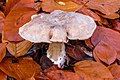 Nevelzwam (nebularis) tussen afgevallen beukenblad
 -
 Cluded Agaric pileus
 -
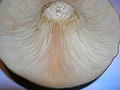 Clouded Agaric Gills
 -
 Clouded Agaric underside
 -
Hexenring Nebelgrauer Trichterling
-
Nevelzwam (nebularis) 14-12-2023
_tussen_afgevallen_beukenblad_(d.j.b.)_01.jpg)


_(d.j.b.)_14-12-2023._(d.j.b).jpg)