Candy cap: Difference between revisions
CSV import |
CSV import Tags: mobile edit mobile web edit |
||
| (One intermediate revision by the same user not shown) | |||
| Line 20: | Line 20: | ||
[[Category:Ingredients]] | [[Category:Ingredients]] | ||
{{food-stub}} | {{food-stub}} | ||
<gallery> | |||
File:Lactarius_camphoratus_-_Lindsey.jpg|Candy_cap | |||
File:Lactarius_rubidus_black_background.jpg|Candy_cap | |||
File:Lactarius_rubidus_spores_1000x_DIC.jpg|Candy_cap | |||
File:2010-08-28_Lactarius_camphoratus_54601.jpg|Candy_cap | |||
File:Lactarius_rubidus_10671.jpg|Candy_cap | |||
</gallery> | |||
== Candy_cap == | |||
<gallery> | |||
File:Lactarius_rubidus_black_background.jpg|Lactarius rubidus on a black background | |||
File:Lactarius_rubidus_spores_1000x_DIC.jpg|Lactarius rubidus spores at 1000x magnification using DIC | |||
File:2010-08-28_Lactarius_camphoratus_54601.jpg|Lactarius camphoratus | |||
File:Lactarius_rubidus_10671.jpg|Lactarius rubidus | |||
</gallery> | |||
Latest revision as of 05:00, 18 February 2025
Candy cap is a type of mushroom known scientifically as Lactarius rubidus. This mushroom is highly valued for its distinctive maple syrup-like aroma and flavor, making it a unique ingredient in both savory and sweet dishes. Candy caps are primarily found in the forests of the Pacific Northwest of the United States and in some parts of Canada, thriving in damp, wooded areas.
Description[edit]
Candy cap mushrooms are small to medium in size, with caps ranging from 1 to 5 centimeters in diameter. The caps are typically convex, becoming more flattened or slightly depressed in the center as they mature. Their color can vary from a light orange to a reddish-brown. The gills under the cap are closely spaced and run down the stem, which is similar in color to the cap but paler. One of the most remarkable features of candy caps is their intense aroma, which is often compared to maple syrup or burnt sugar, especially when the mushrooms are dried.
Culinary Uses[edit]
Candy caps are highly sought after for their unique flavor and aroma, which can be used to enhance a variety of dishes. They are most commonly used in desserts, such as ice cream, custards, and baked goods, where their sweet, maple-like flavor can be showcased. However, they are also used in savory dishes, adding a sweet and complex note to sauces, soups, and meat dishes. The mushrooms are typically used dried, as the drying process intensifies their flavor and aroma.
Foraging and Identification[edit]
Foragers seeking candy cap mushrooms should be well-versed in mushroom identification, as there are several look-alikes that could be mistaken for candy caps. Key identification features include the mushroom's distinctive aroma, its reddish-brown color, and the presence of milk or latex when the gills or stem are cut or broken. Foraging for candy caps is best done in late fall to early winter, following the first heavy rains of the season.
Conservation[edit]
While candy cap mushrooms are not currently considered endangered, their habitats are susceptible to environmental threats such as deforestation, pollution, and climate change. Sustainable foraging practices are encouraged to ensure that candy cap populations remain healthy and viable for future generations.
Culinary and Cultural Significance[edit]
The use of candy cap mushrooms in cooking is a testament to the culinary creativity and biodiversity of the Pacific Northwest. They have become a symbol of the region's rich foraging culture and are celebrated in local food festivals and culinary events. The unique flavor of candy caps has also inspired chefs and food enthusiasts around the world to experiment with incorporating wild mushrooms into sweet dishes, expanding the boundaries of traditional gastronomy.

-
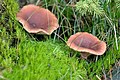 Candy_cap
 -
 Candy_cap
 -
 Candy_cap
 -
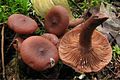 Candy_cap
 -
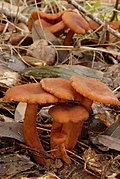 Candy_cap


Candy_cap[edit]
-
Lactarius rubidus on a black background
-
Lactarius rubidus spores at 1000x magnification using DIC
-
Lactarius camphoratus
-
Lactarius rubidus
