Tortas de aceite: Difference between revisions
CSV import Tags: mobile edit mobile web edit |
CSV import Tags: mobile edit mobile web edit |
||
| (2 intermediate revisions by the same user not shown) | |||
| Line 1: | Line 1: | ||
{{ | {{short description|Spanish olive oil flatbread}} | ||
{{Use dmy dates|date=October 2023}} | |||
'''Tortas de Aceite''' are a traditional Spanish pastry originating from the region of [[Andalusia]]. These pastries are known for their light, flaky texture and distinctive flavor, which is primarily derived from the use of [[olive oil]]. | |||
==History== | ==History== | ||
The | The origins of tortas de aceite can be traced back to the [[Moorish]] influence in southern Spain. The use of olive oil and the method of preparation reflect the culinary traditions brought to the Iberian Peninsula during the period of [[Al-Andalus]]. Over time, these pastries have become a staple in Andalusian cuisine and are enjoyed throughout [[Spain]]. | ||
==Ingredients | ==Ingredients== | ||
The | The primary ingredients in tortas de aceite include: | ||
* | * [[Olive oil]] | ||
* | * [[Flour]] | ||
* Sugar | * [[Sugar]] | ||
* | * [[Anise]] seeds | ||
* | * [[Sesame]] seeds | ||
* | * [[Salt]] | ||
Some variations may include additional ingredients such as [[almonds]] or [[cinnamon]] to enhance the flavor. | |||
== | ==Preparation== | ||
[[File:Tortas_de_Aceite.JPG|thumb|right|Tortas de Aceite]] | |||
The preparation of tortas de aceite involves mixing the dry ingredients with olive oil to form a dough. This dough is then rolled out into thin, round discs. The discs are sprinkled with sugar and sometimes additional seeds before being baked until they are golden brown and crisp. | |||
==Cultural Significance== | ==Cultural Significance== | ||
Tortas de aceite are often enjoyed as a snack or dessert and are commonly paired with [[coffee]] or [[tea]]. They are also a popular item during [[festivals]] and [[celebrations]] in Andalusia, reflecting their cultural importance in the region. | |||
== | ==Related pages== | ||
* [[Andalusian cuisine]] | * [[Andalusian cuisine]] | ||
* [[Olive oil]] | * [[Olive oil]] | ||
* [[ | * [[Spanish pastries]] | ||
[[Category:Spanish cuisine]] | [[Category:Spanish cuisine]] | ||
[[Category:Pastries]] | [[Category:Pastries]] | ||
[[Category:Andalusian | [[Category:Andalusian culture]] | ||
<gallery> | |||
File:Tortas_de_Aceite.JPG|Tortas de Aceite | |||
</gallery> | |||
Latest revision as of 11:29, 25 February 2025
Spanish olive oil flatbread
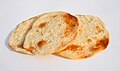
Tortas de Aceite are a traditional Spanish pastry originating from the region of Andalusia. These pastries are known for their light, flaky texture and distinctive flavor, which is primarily derived from the use of olive oil.
History[edit]
The origins of tortas de aceite can be traced back to the Moorish influence in southern Spain. The use of olive oil and the method of preparation reflect the culinary traditions brought to the Iberian Peninsula during the period of Al-Andalus. Over time, these pastries have become a staple in Andalusian cuisine and are enjoyed throughout Spain.
Ingredients[edit]
The primary ingredients in tortas de aceite include:
Some variations may include additional ingredients such as almonds or cinnamon to enhance the flavor.
Preparation[edit]

The preparation of tortas de aceite involves mixing the dry ingredients with olive oil to form a dough. This dough is then rolled out into thin, round discs. The discs are sprinkled with sugar and sometimes additional seeds before being baked until they are golden brown and crisp.
Cultural Significance[edit]
Tortas de aceite are often enjoyed as a snack or dessert and are commonly paired with coffee or tea. They are also a popular item during festivals and celebrations in Andalusia, reflecting their cultural importance in the region.
Related pages[edit]
-
 Tortas de Aceite
