Rete tubular ectasia: Difference between revisions
CSV import Tags: mobile edit mobile web edit |
CSV import |
||
| Line 23: | Line 23: | ||
{{medicine-stub}} | {{medicine-stub}} | ||
<gallery> | |||
File:Tubular ectasia of rete testis - 81jm - Sono.jpg|Rete tubular ectasia | |||
File:Tubular ectasia of the rete testis-0022a.jpg|Rete tubular ectasia | |||
File:Tubular ectasia of the rete testis-0023a.jpg|Rete tubular ectasia | |||
File:Tubular ectasia of the rete testis-0028.jpg|Rete tubular ectasia | |||
</gallery> | |||
Latest revision as of 01:13, 20 February 2025
Rete Tubular Ectasia is a benign condition affecting the rete testis, a network of tubules that are responsible for transporting sperm from the seminiferous tubules to the epididymis. This condition is characterized by the dilation or enlargement of these tubules. Rete tubular ectasia is often discovered incidentally during evaluations for other conditions, such as testicular cancer or infertility. Despite its benign nature, understanding rete tubular ectasia is important for distinguishing it from more serious conditions.
Causes and Risk Factors[edit]
The exact cause of rete tubular ectasia is not well understood. However, it is thought to be associated with obstruction or partial blockage of the tubules within the rete testis. This obstruction can be due to various factors, including previous infections, trauma, or surgeries involving the testicular area. Age-related changes may also contribute to the development of this condition, making it more common in older men.
Symptoms[edit]
Rete tubular ectasia is usually asymptomatic, meaning it does not produce noticeable symptoms. In most cases, it is detected during ultrasound examinations performed for other reasons. When symptoms do occur, they may include discomfort or a feeling of heaviness in the affected testicle.
Diagnosis[edit]
The diagnosis of rete tubular ectasia is primarily made through imaging techniques, with ultrasound being the most commonly used method. On ultrasound, rete tubular ectasia appears as cystic dilations within the mediastinum testis, which is the central part of the testicle where the rete testis is located. The condition is often bilateral, affecting both testicles.
Treatment[edit]
Since rete tubular ectasia is a benign condition that typically does not cause symptoms or lead to complications, treatment is usually not necessary. Management focuses on monitoring the condition to ensure it does not mimic or mask the symptoms of more serious conditions, such as testicular cancer. In cases where rete tubular ectasia is associated with discomfort, conservative measures such as scrotal support or pain management may be recommended.
Prognosis[edit]
The prognosis for individuals with rete tubular ectasia is excellent, as the condition is benign and does not affect fertility or the function of the testicles. Regular follow-up may be advised to monitor the condition over time, especially if it was discovered during the evaluation for other testicular conditions.
Conclusion[edit]
Rete tubular ectasia is a benign and usually asymptomatic condition that involves the dilation of the tubules within the rete testis. It is important for healthcare providers to be aware of this condition to differentiate it from more serious testicular diseases. For patients, understanding that rete tubular ectasia is benign and does not impact testicular function can provide reassurance.

-
 Rete tubular ectasia
 -
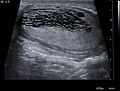 Rete tubular ectasia
 -
 Rete tubular ectasia
 -
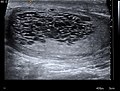 Rete tubular ectasia


