Catabolite activator protein: Difference between revisions
CSV import Tags: mobile edit mobile web edit |
CSV import Tags: mobile edit mobile web edit |
||
| Line 23: | Line 23: | ||
[[Category:Gene expression]] | [[Category:Gene expression]] | ||
{{biology-stub}} | {{biology-stub}} | ||
== Catabolite activator protein == | |||
<gallery> | |||
File:048-CataboliteActivatorProtein-1cgp.tiff | |||
</gallery> | |||
Latest revision as of 22:14, 16 February 2025
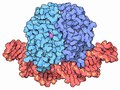
Catabolite Activator Protein (CAP), also known as CRP (cAMP Receptor Protein), is a transcription factor that facilitates gene expression in bacteria, primarily in response to changes in cellular concentration of cyclic AMP (cAMP). CAP plays a crucial role in the utilization of different sugars by bacteria, exemplifying a process known as catabolite repression, which is a part of the broader regulatory mechanism termed carbon catabolite repression.
Overview[edit]
In the presence of high concentrations of glucose, the preferred carbon source for many bacteria, the synthesis of cAMP is inhibited. This leads to a low intracellular concentration of cAMP, which in turn prevents the binding of CAP to DNA. Without CAP-cAMP complex formation, the transcription of certain genes, especially those involved in the metabolism of alternative carbon sources, is downregulated. Conversely, when glucose levels are low, cAMP levels rise, facilitating the formation of the CAP-cAMP complex. This complex then binds to specific DNA sequences known as CAP-binding sites, located near the promoters of certain genes, enhancing their transcription.
Function[edit]
The primary function of CAP is to regulate the transcription of genes involved in the metabolism of non-glucose sugars, such as lactose and arabinose, thereby allowing bacteria to adapt to changes in nutrient availability. CAP achieves this by binding to the promoter regions of these genes in a cAMP-dependent manner, thereby enhancing the affinity of RNA polymerase for these promoters and increasing transcription rates.
CAP-cAMP Complex Formation[edit]
The binding of cAMP to CAP induces a conformational change in CAP that allows it to bind to DNA. The CAP-cAMP complex recognizes and binds to specific DNA sequences, facilitating the recruitment of RNA polymerase to the promoter and initiating transcription. The efficiency of this process is influenced by the nature of the CAP-binding site and the presence of other regulatory proteins that may interact with CAP.
Role in Catabolite Repression[edit]
Catabolite repression is a regulatory mechanism that enables bacteria to preferentially metabolize certain sugars over others. CAP is a central player in this process, as it is directly involved in the activation of genes necessary for the metabolism of alternative carbon sources when glucose is scarce. This ensures that bacteria efficiently utilize available nutrients and adapt to changing environmental conditions.
Genetic Regulation[edit]
The gene encoding CAP, crp, is itself subject to complex regulation, ensuring that CAP levels are appropriately adjusted in response to the cell's metabolic state. This regulation involves both transcriptional and post-transcriptional mechanisms, allowing for a finely tuned response to changes in nutrient availability.
Clinical and Biotechnological Applications[edit]
Understanding the role of CAP in bacterial metabolism has implications for both clinical medicine and biotechnology. In medicine, targeting the CAP-cAMP pathway could lead to new strategies for combating bacterial infections. In biotechnology, manipulating CAP-regulated pathways can enhance the production of commercially important metabolites.