Quantum electrodynamics: Difference between revisions
CSV import |
CSV import |
||
| Line 27: | Line 27: | ||
[[Category:Quantum Field Theory]] | [[Category:Quantum Field Theory]] | ||
{{physics-stub}} | {{physics-stub}} | ||
== Quantum electrodynamics gallery == | |||
<gallery> | |||
File:Dirac 3.jpg|Dirac | |||
File:Hans Bethe.jpg|Hans Bethe | |||
File:Feynman and Oppenheimer at Los Alamos.jpg|Feynman and Oppenheimer at Los Alamos | |||
File:Feynman Diagram Components.svg|Feynman Diagram Components | |||
File:Compton Scattering.svg|Compton Scattering | |||
File:Feynmans QED probability amplitudes.gif|Feynman's QED Probability Amplitudes | |||
File:AdditionComplexes.svg|Addition Complexes | |||
File:MultiplicationComplexes.svg|Multiplication Complexes | |||
File:Electron self energy loop.svg|Electron Self Energy Loop | |||
File:qed rules.jpg|QED Rules | |||
</gallery> | |||
Latest revision as of 05:47, 3 March 2025
Quantum Electrodynamics (QED) is the quantum field theory of the electromagnetic force. Governing how light and matter interact, it extends the theory of quantum mechanics to include special relativity, combining to form the foundation of particle physics. QED mathematically describes all phenomena involving electrically charged particles interacting by means of exchange of photons, and thus, it accounts for the electromagnetic forces.
Overview[edit]
QED is a relativistic theory in that it incorporates Einstein's theory of special relativity. It provides a framework for the quantum behavior of particles with spin 1/2 (fermions) as they interact with the electromagnetic field. The theory is based on the principle that the electromagnetic force can be described as a force carrier, which in this case is the photon, mediating interactions between charged particles.
History[edit]
The development of QED began with the work of Paul Dirac, who, in 1928, formulated a quantum theory for the electron. The theory predicted the existence of antimatter and the Dirac equation. In the late 1940s, Richard Feynman, Julian Schwinger, and Shin'ichirō Tomonaga independently developed the relativistic quantum field theory that became QED. Their work addressed the issues of infinities and renormalization, making the theory consistent and predictive. For their contributions, they were awarded the Nobel Prize in Physics in 1965.
Mathematical Formulation[edit]
The mathematical framework of QED is built upon the concept of path integral formulation and Feynman diagrams. The path integral formulation, introduced by Feynman, allows for the calculation of probabilities of an outcome by summing over all possible paths a particle can take. Feynman diagrams provide a pictorial representation of particle interactions, where lines represent particle trajectories and vertices represent interactions.
Predictions and Applications[edit]
QED has been extremely successful in predicting physical phenomena, such as the Lamb shift, the anomalous magnetic moment of the electron, and the Casimir effect. It also plays a crucial role in the development of technologies such as lasers, quantum computing, and semiconductor devices.
Challenges and Extensions[edit]
While QED is a highly successful theory, it is not the final story in our understanding of the universe. It forms part of the Standard Model of particle physics, which also includes quantum chromodynamics (QCD) for the strong force and a quantum theory for the weak force. Efforts to unify these forces with gravity into a single theoretical framework, such as string theory and quantum gravity, are ongoing.
See Also[edit]

Quantum electrodynamics gallery[edit]
-
 Dirac
Dirac -
 Hans Bethe
 -
 Feynman and Oppenheimer at Los Alamos
 -
 Feynman Diagram Components
 -
 Compton Scattering
 -
 Feynman's QED Probability Amplitudes
 -
 Addition Complexes
 -
 Multiplication Complexes
 -
 Electron Self Energy Loop
 -
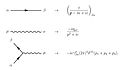 QED Rules


