War on cancer: Difference between revisions
CSV import Tags: mobile edit mobile web edit |
CSV import |
||
| Line 31: | Line 31: | ||
[[Category:Health campaigns]] | [[Category:Health campaigns]] | ||
{{cancer-stub}} | {{cancer-stub}} | ||
<gallery> | |||
File:Richard_Nixon_presidential_portrait.jpg|Official presidential portrait of Richard Nixon | |||
</gallery> | |||
Latest revision as of 22:12, 16 February 2025
War on Cancer refers to the effort to find a cure for cancer by increasing research, improving cancer detection, and enhancing cancer treatment methods. The term was popularized by U.S. President Richard Nixon following the signing of the National Cancer Act of 1971, which aimed to make the conquest of cancer a national priority. This initiative marked a significant increase in funding and research efforts dedicated to understanding and combating various forms of cancer.
Background[edit]
The concept of a "war" against cancer predates the official declaration by Nixon. However, the National Cancer Act of 1971 is often seen as a turning point due to its substantial impact on funding and public awareness. The act led to the establishment and expansion of facilities and cancer research centers across the United States, including the strengthening of the National Cancer Institute (NCI).
Goals and Achievements[edit]
The primary goals of the War on Cancer were to improve survival rates and the quality of life for cancer patients through research, early detection, and new treatment modalities. Over the decades, this initiative has seen significant achievements, including:
- The development of more effective chemotherapy drugs
- Advances in radiation therapy
- The introduction of targeted therapy and immunotherapy
- Improvements in cancer screening and diagnostic technologies
Despite these advancements, the War on Cancer has faced criticism for its militaristic terminology, which some argue oversimplifies the complexity of the disease and the challenges involved in its treatment.
Challenges[edit]
One of the major challenges in the War on Cancer is the disease's complexity and variability. Cancer is not a single disease but a group of diseases, each with its own unique characteristics and challenges. Additionally, the genetic basis of cancer means that it can adapt and evolve resistance to treatments, making long-term management difficult.
Another challenge is the disparity in cancer outcomes among different populations, with socioeconomic status, race, and geography playing significant roles in survival rates. Addressing these disparities remains a critical aspect of the ongoing efforts against cancer.
Future Directions[edit]
The future of the War on Cancer involves a multi-faceted approach that includes:
- Continued research into the molecular and genetic basis of cancer
- The development of personalized medicine, where treatments are tailored to the individual's genetic makeup
- Enhanced focus on prevention through lifestyle changes and vaccination (e.g., HPV vaccine for cervical cancer)
- Reducing disparities in cancer care and outcomes
Conclusion[edit]
The War on Cancer is an ongoing effort that has evolved over the years to encompass a broad range of strategies, from basic research to clinical applications and public health initiatives. While significant progress has been made, the complexity of cancer means that the fight is far from over. Continued investment in research, innovation in treatment, and a commitment to equity in healthcare are essential to making further strides against this disease.

-
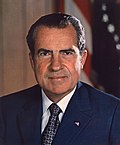 Official presidential portrait of Richard Nixon

