Water fluoridation by country: Difference between revisions
CSV import |
CSV import |
||
| Line 36: | Line 36: | ||
[[Category:Public health]] | [[Category:Public health]] | ||
[[Category:Dental care]] | [[Category:Dental care]] | ||
<gallery> | |||
File:Water-fluoridation-extent-world-equirectangular.svg|Global extent of water fluoridation | |||
File:US-fluoridation-1992-2006.jpeg|Water fluoridation in the United States (1992-2006) | |||
File:Percentage_of_Australian_population_with_access_to_fluoridated_water_as_of_2012.jpg|Percentage of Australian population with access to fluoridated water as of 2012 | |||
</gallery> | |||
Latest revision as of 04:17, 18 February 2025
Water fluoridation by country involves the controlled addition of fluoride to a public water supply to reduce tooth decay. The practice varies worldwide, with some countries implementing it nationwide and others taking a more localized approach or none at all. This article provides an overview of water fluoridation practices in various countries, highlighting the differences in implementation and public opinion.
Overview[edit]
Water fluoridation is the process of adjusting the concentration of fluoride in a public water supply to the level recommended for preventing tooth decay. The optimal fluoride level is typically around 0.7 parts per million (ppm), according to the World Health Organization (WHO). The practice is supported by numerous health organizations as a safe and effective method to prevent dental caries (tooth decay).
By Country[edit]
United States[edit]
The United States was one of the first countries to implement water fluoridation. As of the latest data, approximately 74% of the public water supplies are fluoridated, benefiting around 211 million people. The Centers for Disease Control and Prevention (CDC) has named water fluoridation as one of the ten great public health achievements of the 20th century.
Australia[edit]
Australia has a high level of water fluoridation coverage, with around 90% of the population having access to fluoridated water. The decision to fluoridate water supplies is made by state and territory governments.
United Kingdom[edit]
In the United Kingdom, water fluoridation is a devolved matter. Around 10% of the population receives fluoridated water, mainly in areas of England. The UK Government has considered expanding fluoridation to reduce tooth decay, especially in deprived areas.
Canada[edit]
Canada has a mixed approach to water fluoridation, with some provinces and territories adopting it and others not. Approximately 39% of the population receives fluoridated water. The decision is typically made at the local level, leading to significant variation across the country.
Ireland[edit]
Ireland is one of the few countries with a nationwide policy of water fluoridation, which has been in place since the 1960s. Around 73% of the Irish population receives fluoridated water, making it one of the most extensively fluoridated countries in Europe.
Brazil[edit]
Brazil has a national policy supporting water fluoridation where feasible, and it is widely implemented in larger cities. However, coverage is less consistent in rural areas.
China[edit]
China does not practice water fluoridation due to naturally high fluoride levels in some water sources, which can lead to dental fluorosis. Instead, the country focuses on other fluoride delivery methods, such as salt fluoridation.
Controversy and Opposition[edit]
Water fluoridation has been the subject of controversy and opposition in some regions. Critics argue about potential health risks, ethical concerns regarding mass medication, and the infringement of individual rights. However, extensive research and reviews by health organizations have consistently found water fluoridation to be safe and effective in preventing tooth decay.
Conclusion[edit]
Water fluoridation practices vary significantly by country, reflecting differences in public health policies, availability of alternative fluoride sources, and public opinion. Despite controversies, it remains a key public health strategy for preventing dental caries in many parts of the world.
-
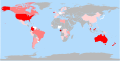 Global extent of water fluoridation
 -
 Water fluoridation in the United States (1992-2006)
 -
 Percentage of Australian population with access to fluoridated water as of 2012


