Iodine monochloride: Difference between revisions
CSV import |
No edit summary |
||
| (2 intermediate revisions by the same user not shown) | |||
| Line 20: | Line 20: | ||
[[Category:Chlorine compounds]] | [[Category:Chlorine compounds]] | ||
{{chemistry-stub}} | {{chemistry-stub}} | ||
<gallery> | |||
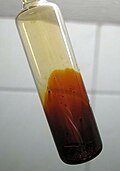
File:Iodine_monochloride1.jpg|Iodine monochloride | |||
</gallery> | |||
Latest revision as of 00:03, 17 March 2025
Iodine monochloride is a chemical compound with the formula ICl. It is composed of the halogens iodine and chlorine, with iodine being in the +1 oxidation state. Iodine monochloride exists in two forms: a stable dark brown solid that melts at 27.2°C, and a volatile red-brown liquid. The compound is an interhalogen compound, meaning it is a compound formed between two different halogens.
Iodine monochloride is used in a variety of chemical reactions. It is particularly useful in organic chemistry for the addition of iodine and chlorine across double bonds (halogenation) and for the conversion of alkenes to alkyl iodides. This reactivity is due to the polar nature of the I-Cl bond, with iodine being less electronegative than chlorine, making the iodine atom a site for nucleophilic attack.
The synthesis of iodine monochloride involves the direct combination of the elements iodine and chlorine. The reaction can be controlled to produce either the solid or liquid form. Safety precautions are necessary when handling iodine monochloride due to its corrosive nature and potential to release toxic gases upon decomposition.
Properties[edit]
Iodine monochloride has distinctive physical and chemical properties. It is soluble in water, where it undergoes hydrolysis to form hydrochloric acid and hypoiodous acid. It is also soluble in organic solvents, which makes it useful in organic synthesis. The compound's ability to participate in electrophilic addition reactions with alkenes is a key aspect of its reactivity.
Applications[edit]
In addition to its use in organic synthesis, iodine monochloride has applications in analytical chemistry. It is used as a reagent for the determination of certain types of organic compounds and for the iodination of aromatic compounds. The compound's strong oxidizing properties also make it useful in the synthesis of certain types of organic iodides.
Safety[edit]
Handling iodine monochloride requires caution. It is corrosive to the skin and mucous membranes, and its vapors can cause respiratory irritation. Appropriate personal protective equipment, including gloves and eye protection, should be used when working with this compound. In case of exposure, prompt washing with water and seeking medical advice are recommended.

-
 Iodine monochloride


