Buckling: Difference between revisions
CSV import |
CSV import |
||
| Line 31: | Line 31: | ||
[[Category:Aerospace engineering]] | [[Category:Aerospace engineering]] | ||
{{engineering-stub}} | {{engineering-stub}} | ||
<gallery> | |||
File:B52-buckling.jpg|Buckling | |||
File:Buckled_column.svg|Buckled column | |||
File:Buckling_beam_element.svg|Buckling beam element | |||
File:ColumnEffectiveLength.png|Column effective length | |||
File:Buckledmodel.JPG|Buckled model | |||
File:Biegedrillknicken-svg.svg|Biegedrillknicken | |||
File:Saddle-node-strut.png|Saddle-node strut | |||
File:Supercritical-strut.png|Supercritical strut | |||
File:Subcritical-strut.png|Subcritical strut | |||
File:Transcritical-strut.png|Transcritical strut | |||
File:Saddle-node-animation.gif|Saddle-node animation | |||
File:Supercritical.gif|Supercritical | |||
</gallery> | |||
Latest revision as of 11:56, 18 February 2025
Buckling refers to a sudden failure mode of a structural member subjected to high compressive stress, where the actual compressive stress at the point of failure is less than the ultimate compressive stresses that the material is capable of withstanding. Buckling leads to a deformation, typically a bending or collapsing, of the structure under load, which is not proportional to the applied load. This phenomenon is critical in the field of structural engineering, mechanical engineering, and aerospace engineering, among others, where stability analysis is essential for the safe design of slender structures like columns, beams, and shells.
Overview[edit]
Buckling occurs when a structure loses stability due to an applied load and deforms into a different shape. The load at which this occurs is known as the critical load. The behavior of a structure undergoing buckling is highly sensitive to slight imperfections in geometry, loading, or material properties, which makes it a complex phenomenon to predict and analyze accurately.
Types of Buckling[edit]
There are several types of buckling, including:
- Euler Buckling: The classical theory of buckling, applicable to long, slender columns subjected to axial compressive forces. It is described by the Euler's critical load formula.
- Lateral-torsional Buckling: Occurs in open or non-symmetric cross-section beams where the compression side of the member bends and twists.
- Local Buckling: Seen in thin-walled members where the local stress exceeds the critical stress for the material in a confined area, leading to a local failure.
- Plate Buckling: Occurs in flat plates subjected to compression loads, such as the wings of an airplane.
Factors Influencing Buckling[edit]
Several factors can influence the buckling behavior of a structure, including:
- Geometric Imperfections: Real structures often have imperfections that can significantly reduce their buckling strength.
- Material Properties: The strength, modulus of elasticity, and yield stress of the material can affect the buckling resistance.
- Boundary Conditions: The way a structural member is supported can greatly influence its susceptibility to buckling.
Prevention and Mitigation[edit]
To prevent or mitigate buckling, engineers may employ various strategies, such as:
- Increasing the cross-sectional area or moment of inertia of the member.
- Using materials with higher modulus of elasticity.
- Introducing bracing or stiffening elements to increase the overall stability of the structure.
Applications and Examples[edit]
Buckling analysis is crucial in the design of columns in buildings, aircraft fuselage, ship hulls, and even in the design of microscale devices. Understanding the buckling behavior of materials and structures is essential for ensuring safety and reliability in a wide range of engineering applications.
See Also[edit]
-
 Buckling
 -
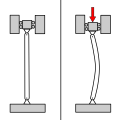 Buckled column
 -
Buckling beam element
-
Column effective length
-
Buckled model
-
Biegedrillknicken
-
Saddle-node strut
-
Supercritical strut
-
Subcritical strut
-
Transcritical strut
-
Saddle-node animation
-
Supercritical


