Elf: Difference between revisions
CSV import Tags: mobile edit mobile web edit |
CSV import |
||
| (One intermediate revision by the same user not shown) | |||
| Line 1: | Line 1: | ||
{{ | {{Fantasy-stub}} | ||
''' | '''Elf''' is a mythical creature that originates from [[Germanic mythology]] and [[Norse mythology]], and has been widely popularized in modern [[fantasy literature]] and media. Elves are often depicted as youthful-seeming beings, possessing great beauty and longevity, alongside a range of magical powers. The concept of elves has evolved significantly over the centuries, influenced by folklore, literature, and popular culture. | ||
== | ==Etymology== | ||
The | The word "elf" comes from the Old English word ''ælf'', which has parallels in all other [[Germanic languages]]. The Germanic word is originally from the Proto-Germanic '*albiz*', which is possibly derived from a Proto-Indo-European root meaning 'white' or 'bright'. | ||
==Characteristics== | |||
Elves are commonly described as taller than humans with pointed ears and ethereal features. They are often associated with nature, living in forests, and having a deep connection to the earth and its wildlife. Elves are typically portrayed as wise, with a deep knowledge of magic and ancient lore. In many depictions, elves are immortal or live exceptionally long lives. | |||
==Cultural Depictions== | |||
### In Mythology | |||
In traditional Germanic and Norse lore, elves are often divided into light elves (''Ljósálfar'') and dark elves (''Dökkálfar''), with the former residing in the heavens and the latter found underground. They could be benevolent or malevolent towards humans. | |||
### In Literature | |||
Elves | Elves gained immense popularity through the works of [[J.R.R. Tolkien]], who redefined elves in his [[Middle-earth]] legendarium, notably in ''[[The Hobbit]]'' and ''[[The Lord of the Rings]]''. Tolkien’s elves are an ancient race of powerful beings who are more noble and wise than humans, with intricate cultures and languages. | ||
In modern fantasy, | ### In Popular Culture | ||
Elves have become staple characters in modern fantasy genres, appearing in a myriad of books, films, and video games. They are often key characters in high fantasy settings, such as in the ''[[Warcraft]]'' series, ''[[The Elder Scrolls]]'', and ''[[Dragon Age]]''. | |||
== | ==Elves in Festive Culture== | ||
Elves | Elves also play a prominent role in Christmas folklore, particularly in American and other Western cultures, where they are depicted as Santa Claus's helpers, making toys in his workshop at the North Pole. | ||
==See Also== | ==See Also== | ||
* [[Fairy]] | * [[Fairy]] | ||
* [[Gnome]] | |||
* [[Troll]] | |||
* [[Dwarf (mythology)]] | * [[Dwarf (mythology)]] | ||
[[Category:Mythological creatures]] | [[Category:Mythological creatures]] | ||
[[Category:Fantasy creatures]] | [[Category:Fantasy creatures]] | ||
== Elf gallery == | |||
<gallery> | |||
File:Ängsälvor - Nils Blommér 1850.jpg|Ängsälvor - Nils Blommér 1850 | |||
File:Phonological development of the word elf in English.png|Phonological development of the word elf in English | |||
File:Alden Valley - geograph.org.uk - 417197.jpg|Alden Valley | |||
File:Eadwine Psalter f 66r detail of Christ and demons attacking psalmist.png|Eadwine Psalter f 66r detail of Christ and demons attacking psalmist | |||
File:Beowulf - ylfe.jpg|Beowulf - ylfe | |||
File:Semantic field diagram of words for sentient beings in Old Norse.gif|Semantic field diagram of words for sentient beings in Old Norse | |||
File:Glasgow Botanic Gardens. Kibble Palace. William Goscombe John - 'The Elf', 1899.jpg|Glasgow Botanic Gardens. Kibble Palace. William Goscombe John - 'The Elf', 1899 | |||
File:Margarethe-Luther-1527.jpg|Margarethe Luther 1527 | |||
File:Scott-Minstrelsy-Works-v1-p195-True Thomas tune.jpg|Scott Minstrelsy Works v1 p195 True Thomas tune | |||
File:Älvalek.jpg|Älvalek | |||
</gallery> | |||
Latest revision as of 05:15, 3 March 2025

Elf is a mythical creature that originates from Germanic mythology and Norse mythology, and has been widely popularized in modern fantasy literature and media. Elves are often depicted as youthful-seeming beings, possessing great beauty and longevity, alongside a range of magical powers. The concept of elves has evolved significantly over the centuries, influenced by folklore, literature, and popular culture.
Etymology[edit]
The word "elf" comes from the Old English word ælf, which has parallels in all other Germanic languages. The Germanic word is originally from the Proto-Germanic '*albiz*', which is possibly derived from a Proto-Indo-European root meaning 'white' or 'bright'.
Characteristics[edit]
Elves are commonly described as taller than humans with pointed ears and ethereal features. They are often associated with nature, living in forests, and having a deep connection to the earth and its wildlife. Elves are typically portrayed as wise, with a deep knowledge of magic and ancient lore. In many depictions, elves are immortal or live exceptionally long lives.
Cultural Depictions[edit]
- In Mythology
In traditional Germanic and Norse lore, elves are often divided into light elves (Ljósálfar) and dark elves (Dökkálfar), with the former residing in the heavens and the latter found underground. They could be benevolent or malevolent towards humans.
- In Literature
Elves gained immense popularity through the works of J.R.R. Tolkien, who redefined elves in his Middle-earth legendarium, notably in The Hobbit and The Lord of the Rings. Tolkien’s elves are an ancient race of powerful beings who are more noble and wise than humans, with intricate cultures and languages.
- In Popular Culture
Elves have become staple characters in modern fantasy genres, appearing in a myriad of books, films, and video games. They are often key characters in high fantasy settings, such as in the Warcraft series, The Elder Scrolls, and Dragon Age.
Elves in Festive Culture[edit]
Elves also play a prominent role in Christmas folklore, particularly in American and other Western cultures, where they are depicted as Santa Claus's helpers, making toys in his workshop at the North Pole.
See Also[edit]
Elf gallery[edit]
-
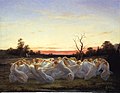 Ängsälvor - Nils Blommér 1850
 -
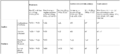 Phonological development of the word elf in English
 -
 Alden Valley
 -
 Eadwine Psalter f 66r detail of Christ and demons attacking psalmist
 -
 Beowulf - ylfe
 -
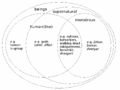 Semantic field diagram of words for sentient beings in Old Norse
 -
 Glasgow Botanic Gardens. Kibble Palace. William Goscombe John - 'The Elf', 1899
 -
 Margarethe Luther 1527
 -
 Scott Minstrelsy Works v1 p195 True Thomas tune
 -
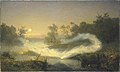 Älvalek


