Switch: Difference between revisions
CSV import Tags: mobile edit mobile web edit |
CSV import |
||
| Line 38: | Line 38: | ||
{{technology-stub}} | {{technology-stub}} | ||
<gallery> | |||
File:Switches-electrical.agr.jpg|Switch | |||
File:Tactile_switches.jpg|Tactile switches | |||
File:On-Off_Switch.jpg|On-Off Switch | |||
File:Tpst.jpg|TPST | |||
File:SPST-Switch.svg|SPST Switch | |||
File:Symbol_circuit_breaker_(one-pole).svg|One-pole Circuit Breaker | |||
File:SPST-NC-Switch.svg|SPST-NC Switch | |||
File:SPDT-Switch.svg|SPDT Switch | |||
File:Symbol_change_over_switch.svg|Change Over Switch | |||
File:Symbol_Series_switch.svg|Series Switch | |||
File:DPST-symbol.svg|DPST Switch | |||
File:Symbol_circuit_breaker_(two-pole).svg|Two-pole Circuit Breaker | |||
</gallery> | |||
Latest revision as of 11:57, 18 February 2025

A switch is a device used to connect or disconnect an electrical circuit, or to divert current from one conductor to another. Switches can be simple binary devices that are either in a closed (on) or open (off) state, or they can be more complex, designed to control a wide range of electrical functions. The operation of switches can be manual, such as a light switch, or automatic, based on specific criteria, such as a pressure switch that activates when a certain pressure threshold is reached.
Types of Switches[edit]
Switches come in various types and functionalities, including, but not limited to:
- Toggle switch: A switch that is manually operated by moving a lever back and forth to open or close an electrical circuit.
- Push-button switch: A switch that is operated by pressing a button; releasing the button usually returns the switch to its original state.
- Rotary switch: A switch that operates by rotating a knob; different positions of the knob connect different circuits.
- Reed switch: A magnetic switch that operates when a magnetic field brings two reeds together, closing the circuit.
- Pressure switch: A switch that activates based on the pressure of a fluid or gas reaching a certain threshold.
- Temperature switch: A switch that activates based on the temperature of the environment or a specific object reaching a certain level.
Applications[edit]
Switches are used in a multitude of applications across various industries. Some common applications include:
- Lighting control: Using switches to turn lights on and off.
- Industrial control systems: Employing switches to control machinery and processes.
- Consumer electronics: Utilizing switches in devices like computers, smartphones, and home appliances for various functions.
- Automotive systems: Implementing switches for functions such as ignition, lights, and windshield wipers.
Technology and Innovations[edit]
With advancements in technology, switches have evolved from mechanical devices to include solid-state switches that use semiconductor devices to control the flow of electricity. These solid-state switches, such as transistors and thyristors, offer advantages in terms of speed, reliability, and efficiency over traditional mechanical switches.
Safety and Standards[edit]
Safety is a critical aspect of switch design and operation. Standards such as those set by the International Electrotechnical Commission (IEC) and the Underwriters Laboratories (UL) ensure that switches meet specific requirements to prevent electrical accidents and ensure the safety of users.
See Also[edit]
 | This technology-related article is a stub. You can help Wikipedia by adding missing information. |
-
 Switch
 -
 Tactile switches
 -
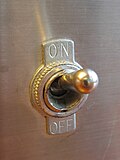 On-Off Switch
 -
 TPST
TPST -
 SPST Switch
 -
 One-pole Circuit Breaker
 -
 SPST-NC Switch
 -
 SPDT Switch
 -
 Change Over Switch
 -
 Series Switch
 -
 DPST Switch
 -
 Two-pole Circuit Breaker


.svg)


.svg)
