Hectocotylus: Difference between revisions
CSV import |
CSV import |
||
| Line 18: | Line 18: | ||
[[Category:Animal anatomy]] | [[Category:Animal anatomy]] | ||
{{biology-stub}} | {{biology-stub}} | ||
<gallery> | |||
File:Hectocotyle1.jpg|Hectocotyle1 | |||
File:Hectocotylized_arm_of_a_squid.jpg|Hectocotylized arm of a squid | |||
File:Hectocotylized_arm_of_an_octopod.jpg|Hectocotylized arm of an octopod | |||
File:Abraliopsis_morisi_hectocotylus-English.jpg|Abraliopsis morisi hectocotylus | |||
File:Argonauta_bottgeri_hectocotylus-2.jpg|Argonauta bottgeri hectocotylus | |||
File:Hectocotyle1-2.jpg|Hectocotyle1-2 | |||
File:Bathypolypus_arcticus_hectocotylus-2.jpg|Bathypolypus arcticus hectocotylus | |||
File:Graneledone_verrucosa_hectocotylus.jpg|Graneledone verrucosa hectocotylus | |||
File:Haliphron_atlanticus_hectocotylus.jpg|Haliphron atlanticus hectocotylus | |||
File:Ocythoe_tuberculata_hectocotylus.jpg|Ocythoe tuberculata hectocotylus | |||
</gallery> | |||
Latest revision as of 21:04, 25 February 2025
Hectocotylus refers to a specialized arm or tentacle found in male cephalopods, particularly within the orders of octopuses, squids, and cuttlefish. This structure is utilized during the mating process to transfer spermatophores (sperm packets) from the male to the female, facilitating fertilization. The hectocotylus is characterized by its modification; it may have a reduced number of suckers, be elongated, or have other structural adaptations that distinguish it from the other arms or tentacles of the cephalopod.
Structure and Function[edit]
The hectocotylus varies significantly in structure among different cephalopod species. In many cases, it is morphologically distinct from the other arms, equipped with specialized modifications that aid in the secure transfer of spermatophores to the female. For example, in some species of octopus, the hectocotylus is capable of detaching from the male and remaining inside the female's mantle cavity to ensure sperm transfer.
The process of transferring spermatophores can be complex and is often species-specific. The male cephalopod typically loads the spermatophores into the hectocotylus, then inserts the arm into the female's mantle cavity or a specialized receptacle to deposit the spermatophores.
Evolutionary Significance[edit]
The evolution of the hectocotylus is a fascinating aspect of cephalopod biology, highlighting the diverse reproductive strategies within this group. This adaptation allows for direct sperm transfer in an aquatic environment, which can increase the chances of successful fertilization. The specific modifications of the hectocotylus in different species reflect a range of evolutionary solutions to the challenges of mating in the marine environment.
Research and Study[edit]
The study of the hectocotylus provides insights into the reproductive biology, behavior, and evolution of cephalopods. Researchers examine the structure and function of the hectocotylus to understand mating behaviors, reproductive success, and the evolutionary pressures that have shaped these unique adaptations.
Conservation and Importance[edit]
Understanding the reproductive mechanisms of cephalopods, including the role of the hectocotylus, is crucial for the conservation and management of these species. Many cephalopods are of commercial importance and are subject to fishing pressures. Knowledge of their reproductive biology can inform sustainable management practices and conservation efforts.

-
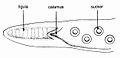
 Hectocotyle1
 -
 Hectocotylized arm of a squid
 -
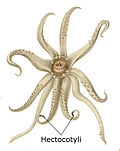
 Hectocotylized arm of an octopod
 -
 Abraliopsis morisi hectocotylus
 -
 Argonauta bottgeri hectocotylus
 -
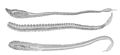 Hectocotyle1-2
 -
 Bathypolypus arcticus hectocotylus
 -
 Graneledone verrucosa hectocotylus
 -
 Haliphron atlanticus hectocotylus
 -
 Ocythoe tuberculata hectocotylus


