Thermocline: Difference between revisions
CSV import |
CSV import |
||
| Line 47: | Line 47: | ||
{{Template:Environment}} | {{Template:Environment}} | ||
{{medicine-stub}} | {{medicine-stub}} | ||
<gallery> | |||
File:THERMOCLINE.png|Thermocline | |||
File:ThermoclineSeasonDepth.png|Seasonal Depth of Thermocline | |||
File:Moon_jellyfishes_disturbing_the_top_water_layer_of_Gullmarn_fjord_1.jpg|Moon Jellyfishes Disturbing the Top Water Layer of Gullmarn Fjord | |||
File:Lake_Stratification_(11).svg|Lake Stratification | |||
</gallery> | |||
Latest revision as of 04:32, 18 February 2025
Thermocline refers to a layer in a large body of water, such as an ocean or a lake, that marks a drastic temperature gradient. Unlike the warmer surface layer above it, the thermocline experiences a rapid decrease in temperature with depth. Below the thermocline, the water remains at a nearly constant cold temperature. The existence and depth of the thermocline can vary significantly depending on geographic location, season, and local environmental conditions.
Formation[edit]
The formation of a thermocline is primarily due to the differential heating of water by the sun. The surface layer of the ocean or lake absorbs most of the sunlight, warming up more quickly than the water below. This creates a distinct layer of warmer water on top. Since warm water is less dense than cold water, it remains on the surface, creating a stratified temperature structure in the body of water. Wind and wave action can mix the surface layer, but this mixing rarely extends down to the colder water below the thermocline.
Characteristics[edit]
The characteristics of a thermocline include a sharp change in temperature over a relatively small depth range. This temperature gradient can be as much as 20°C (36°F) over a few meters or tens of meters in the ocean. In freshwater bodies like lakes, the thermocline is often found during the warmer months, while in the ocean, it can be a more permanent feature, although its depth and intensity can vary seasonally and with latitude.
Importance[edit]
Thermoclines are significant for several reasons:
- They act as a barrier to the mixing of surface water and deeper layers, affecting nutrient and oxygen cycles in the water body.
- They play a crucial role in the distribution of marine life, with certain species adapted to live above, within, or below the thermocline.
- They influence weather and climate patterns by affecting ocean circulation and the distribution of heat on the planet.
Types[edit]
There are generally three types of thermoclines observed in aquatic environments:
- Permanent Thermocline: Found in most oceans, where the temperature gradient exists throughout the year.
- Seasonal Thermocline: Develops in the warmer months and disappears in the colder months, commonly observed in lakes and some seas.
- Diurnal Thermocline: Forms during the day due to solar heating and disappears at night, typically observed in very shallow water bodies.
Detection and Measurement[edit]
The presence and characteristics of a thermocline can be detected and measured using various instruments and methods, such as CTD (Conductivity, Temperature, Depth) sensors, XBTs (Expendable Bathythermographs), and ARGO floats. These tools provide valuable data for understanding oceanographic and limnological processes.
Environmental Impact[edit]
Thermoclines have a profound impact on the environment. They can influence the behavior of hurricanes by limiting the amount of heat available to the storm from the ocean surface. In aquatic ecosystems, the thermocline affects the availability of nutrients for phytoplankton, which forms the base of the marine food web.

This article is a oceanography stub. You can help WikiMD by expanding it!
See Also[edit]
References[edit]
<references/>
External Links[edit]
| Oceanography | ||||||||||
|---|---|---|---|---|---|---|---|---|---|---|
This oceanography-related article is a stub.
|

-
 Thermocline
 -
 Seasonal Depth of Thermocline
 -
 Moon Jellyfishes Disturbing the Top Water Layer of Gullmarn Fjord
 -
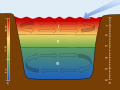 Lake Stratification


.svg)
