Random number generation: Difference between revisions
CSV import |
CSV import |
||
| Line 32: | Line 32: | ||
{{Comp-sci-stub}} | {{Comp-sci-stub}} | ||
== Random number generation gallery == | |||
<gallery> | |||
File:Two red dice 01.svg|Two red dice | |||
File:Demo random SMIL.svg|Demo random SMIL | |||
</gallery> | |||
Latest revision as of 05:24, 3 March 2025
Random number generation is the process of generating a sequence of numbers or symbols that cannot be reasonably predicted better than by a random chance. Random numbers are essential in various fields, including statistics, cryptography, simulation, and gaming. The quality and characteristics of the generated numbers are crucial, depending on the application.
Types of Random Number Generators (RNGs)[edit]
There are primarily two types of RNGs: True Random Number Generators (TRNGs) and Pseudorandom Number Generators (PRNGs).
True Random Number Generators (TRNGs)[edit]
TRNGs generate numbers from a physical process, often based on quantum phenomena or thermal noise. These processes are inherently unpredictable and do not require an initial seed. Examples include radioactive decay and atmospheric noise.
Pseudorandom Number Generators (PRNGs)[edit]
PRNGs use mathematical algorithms to produce sequences of numbers that appear random. PRNGs require an initial value, known as a seed, and will produce the same sequence of numbers from the same seed. Common algorithms include the Linear Congruential Generator (LCG) and the Mersenne Twister.
Applications[edit]
Random number generation has a wide range of applications:
- In cryptography, random numbers are used to generate keys and nonces to secure data.
- In statistical sampling, they are used to select random samples from larger data sets.
- In simulation and modeling, random numbers simulate complex systems and phenomena.
- In gaming, they are used to ensure fairness and unpredictability in games.
Quality and Testing[edit]
The quality of random numbers is paramount, especially in security-sensitive applications. Various statistical tests, such as the Diehard tests and the NIST suite, are used to evaluate the randomness of number sequences.
Challenges[edit]
Despite their importance, generating high-quality random numbers poses challenges. For TRNGs, the rate of generation can be slow, and the devices can be expensive. PRNGs, while fast, can suffer from predictability if their algorithms and seeds are known.
Conclusion[edit]
Random number generation is a critical component in many modern applications. The choice between TRNGs and PRNGs depends on the specific requirements of the application, including speed, security, and cost.

This article is a computer science stub. You can help WikiMD by expanding it!
Random number generation gallery[edit]
-
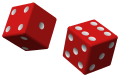 Two red dice
 -
 Demo random SMIL


