Radon difluoride: Difference between revisions
CSV import |
CSV import |
||
| Line 26: | Line 26: | ||
[[Category:Fluorides]] | [[Category:Fluorides]] | ||
{{Chem-stub}} | {{Chem-stub}} | ||
<gallery> | |||
File:Radon-difluoride-CPK.png|Radon difluoride CPK model | |||
</gallery> | |||
Latest revision as of 05:00, 3 March 2025
Radon difluoride (RnF2) is a chemical compound consisting of one radon atom and two fluorine atoms. It is a member of the noble gas compounds, which are notable for their rarity and the inertness of the noble gases under standard conditions. Radon difluoride is of particular interest in the fields of inorganic chemistry and nuclear science due to the radioactive nature of radon.
Properties[edit]
Radon difluoride is a colorless gas under standard conditions. As with other noble gas compounds, it is relatively unstable and can decompose into its constituent elements. The compound is of interest primarily for its theoretical and experimental implications in the study of chemical bonding and the behavior of noble gases in chemical reactions.
Synthesis[edit]
The synthesis of radon difluoride involves the direct reaction of radon gas with fluorine gas under specific conditions. The reaction is highly controlled due to the radioactive nature of radon and the reactivity of fluorine. The process typically requires a low temperature and an inert atmosphere to prevent the decomposition of the product and to ensure the safety of the researchers.
Chemical Reactions[edit]
Radon difluoride can undergo further chemical reactions, although its reactivity is limited due to the stability of the Rn-F bond and the inert nature of radon. Studies on its reactivity help expand the understanding of noble gas chemistry and the potential for noble gases to form stable compounds under certain conditions.
Applications[edit]
The applications of radon difluoride are primarily academic, given the compound's instability and the radioactive hazard posed by radon. Research into radon difluoride and similar compounds can provide insights into the limits of chemical bonding and the potential for synthesizing new materials from noble gases.
Safety[edit]
Handling radon difluoride requires strict safety protocols due to the radioactive nature of radon and the chemical reactivity of fluorine. Safety measures include the use of shielded containment, appropriate ventilation, and monitoring for radiation exposure.
See Also[edit]

-
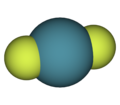 Radon difluoride CPK model

