Tanning lamp: Difference between revisions
CSV import |
CSV import |
||
| Line 35: | Line 35: | ||
{{Medicine-stub}} | {{Medicine-stub}} | ||
<gallery> | |||
File:Tanninglamp.jpg|Tanning lamp | |||
File:Tanninglampend.jpg|End of a tanning lamp | |||
File:Ultraviolet_tanning_bed_lamp_running.JPG|Ultraviolet tanning bed lamp running | |||
File:Tanning-hpbulb.jpg|High pressure tanning bulb | |||
File:Tanning-chokeballast.jpg|Choke ballast for tanning lamp | |||
File:Tanning-starter.jpg|Starter for tanning lamp | |||
File:Tanningballast-choke.gif|Choke ballast diagram | |||
File:Tanningballast-hf.gif|High frequency ballast diagram | |||
File:Lampoutput.png|Lamp output graph | |||
</gallery> | |||
Latest revision as of 11:20, 18 February 2025
Tanning lamp refers to an artificial light source designed to produce ultraviolet (UV) radiation, mimicking the sun's effect on the skin to induce a cosmetic tan. Primarily found in tanning beds or booths, these lamps facilitate skin tanning by emitting UV radiation, which stimulates melanin production in the skin. The use of tanning lamps has been both popular for aesthetic reasons and controversial due to health concerns.
Types of Tanning Lamps[edit]
Tanning lamps can be categorized based on the UV radiation they emit:
- UVA Lamps: Emit long-wave UVA radiation, which penetrates deeper into the skin but is less likely to cause immediate sunburn. UVA lamps are often marketed as "safer" or "bronzing."
- UVB Lamps: Emit short-wave UVB radiation, more closely associated with sunburn but also more effective at stimulating vitamin D production. UVB lamps are typically used for medical treatments, such as psoriasis.
- Combination UVA/UVB Lamps: Provide a mix of UVA and UVB radiation, aiming to balance the tanning effect with a reduced risk of sunburn.
Health Risks and Benefits[edit]
The use of tanning lamps is associated with several health risks and benefits:
Risks[edit]
- Skin Cancer: Prolonged exposure to UV radiation increases the risk of developing skin cancers, including melanoma, basal cell carcinoma, and squamous cell carcinoma.
- Premature Aging: UV radiation can lead to premature skin aging, characterized by wrinkles, leathery skin, and age spots.
- Eye Damage: Without proper eye protection, exposure to UV radiation can harm the eyes, leading to conditions such as cataracts.
Benefits[edit]
- Vitamin D Synthesis: UVB radiation from tanning lamps can promote vitamin D synthesis in the skin, which is essential for bone health and immune function.
- Psoriasis Treatment: UVB lamps are used in phototherapy to treat psoriasis, a condition that causes skin cells to multiply rapidly, leading to scaly patches.
Regulation and Safety[edit]
Due to the health risks associated with UV radiation, the use of tanning lamps is regulated in many countries. Regulations may include age restrictions, mandatory protective eyewear, and limits on exposure time. It is crucial for users to follow safety guidelines to minimize health risks.
Alternatives[edit]
For those seeking a tan without the risks associated with UV radiation, alternatives include:
- Sunless Tanning Products: Lotions, sprays, and gels that temporarily stain the skin.
- Spray Tanning: A professional service that applies a fine mist of sunless tanning solution to the skin.
Conclusion[edit]
While tanning lamps offer a convenient way to achieve a cosmetic tan, it is important to weigh the aesthetic benefits against the potential health risks. Users should consider safer alternatives and adhere to safety guidelines when using tanning lamps.

-
 Tanning lamp
 -
 End of a tanning lamp
 -
 Ultraviolet tanning bed lamp running
 -
 High pressure tanning bulb
 -
 Choke ballast for tanning lamp
 -
 Starter for tanning lamp
 -
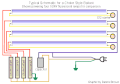 Choke ballast diagram
 -
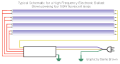 High frequency ballast diagram
 -
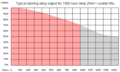 Lamp output graph


