Phoresis: Difference between revisions
CSV import Tags: mobile edit mobile web edit |
CSV import |
||
| Line 27: | Line 27: | ||
{{biology-stub}} | {{biology-stub}} | ||
<gallery> | |||
File:Pseudogarypus_synchrotron_Henderickx_et_al_2012.jpg|Phoresis | |||
File:Male_Bombus_hypnorum_male_with_phoretic_mites,_Botevgrad,_Bulgaria_02.jpg|Phoresis | |||
File:Leptopeza.flavipes.with.Lamprochernes.2.jpg|Phoresis | |||
File:Phoresy_edited.png|Phoresis | |||
File:Nicrophorus_humator_-_sexton_beetle_-_Flickr_-_Nick_Goodrum_Photography.jpg|Phoresis | |||
</gallery> | |||
Latest revision as of 11:27, 18 February 2025
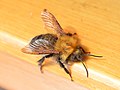
Phoresis (also known as phoresy) is a form of symbiosis in which one organism (the phoront) is transported by another organism (the host). Unlike other forms of symbiosis, such as mutualism, commensalism, and parasitism, phoresis is characterized by the phoront being passively transported by the host, without any physiological or biochemical interaction between the two beyond the transportation itself. This relationship is typically temporary and does not involve any direct benefit or harm to the host.
Types of Phoresis[edit]
Phoresis can be classified based on the nature of the relationship between the phoront and the host:
- Ectophoresis: The phoront is transported on the external surface of the host. An example of ectophoresis is mites on insects.
- Endophoresis: The phoront is transported within the body of the host. This is less common but can be seen in some nematodes within insects.
Mechanisms of Phoresis[edit]
The mechanism of phoresis involves the phoront attaching to the host in some manner. In ectophoresis, this may involve specialized structures or substances that allow the phoront to cling to the host's exterior. In endophoresis, the phoront may enter the host through natural openings or wounds.
Ecological and Evolutionary Significance[edit]
Phoresis plays an important role in the ecology and evolution of many organisms. It can facilitate the dispersal of organisms to new habitats, thus contributing to gene flow and genetic diversity. Phoresis can also be a step towards more complex symbiotic relationships, as it allows different species to interact closely over time.
Examples of Phoresis[edit]
One of the most well-known examples of phoresis involves the relationship between certain species of mites and beetles. The mites attach themselves to the beetles and are transported to new food sources or habitats. Another example is the dispersal of plant seeds by attaching to the fur or feathers of animals.
Research and Study[edit]
The study of phoresis encompasses various disciplines, including biology, ecology, and evolutionary biology. Researchers investigate the mechanisms of attachment and transport, the ecological impacts of phoretic relationships, and the evolutionary pathways that lead from phoresis to other forms of symbiosis.
Conclusion[edit]
Phoresis represents a fascinating aspect of the natural world, showcasing the diverse strategies organisms have evolved to survive and thrive. While it may not involve the direct exchange of resources typical of other symbiotic relationships, its significance in the dispersal and evolution of species is profound.

-
 Phoresis
 -
 Phoresis
 -
 Phoresis
 -
 Phoresis
 -
 Phoresis


