Artificial intelligence in healthcare: Difference between revisions
mNo edit summary |
CSV import |
||
| Line 52: | Line 52: | ||
{{medicine-stub}} | {{medicine-stub}} | ||
== Artificial intelligence in healthcare == | |||
<gallery> | |||
File:X-ray of hand, where bone age is automatically found by BoneXpert software.jpg|X-ray of hand, where bone age is automatically found by BoneXpert software | |||
File:Elderly Man Using Pulse Oximeter.jpg|Elderly Man Using Pulse Oximeter | |||
File:Ki67 calculation by QuPath in a pure seminoma.png|Ki67 calculation by QuPath in a pure seminoma | |||
File:Elon Musk and the Neuralink Future.jpg|Elon Musk and the Neuralink Future | |||
File:Workshop GDPR compliance at the 2019 Global Entrepreneurship Summit.jpg|Workshop GDPR compliance at the 2019 Global Entrepreneurship Summit | |||
File:Logo of the United States Food and Drug Administration.svg|Logo of the United States Food and Drug Administration | |||
</gallery> | |||
Latest revision as of 01:09, 20 February 2025
Artificial Intelligence in Healthcare
Artificial intelligence (AI) in healthcare is the use of complex algorithms and software to emulate human cognition in the analysis, interpretation, and comprehension of complicated medical and healthcare data. Distinctly, AI is the ability for computer algorithms to approximate conclusions without direct human input. What distinguishes AI technology from traditional technologies in health care is the ability to gather data, process it, and give a well-defined output to the end-user. AI does this through machine learning algorithms and deep learning. These processes allow the software to learn automatically from patterns or features in the data.
Overview[edit]
AI in healthcare aims to assist medical practitioners in improving patient outcomes, reduce costs, and enhance the efficiency of healthcare delivery systems. It encompasses a variety of technologies and tools, some of which include machine learning, natural language processing (NLP), chatbots, and robotics.
Machine Learning[edit]
Machine learning in healthcare allows for the analysis of vast amounts of data to identify patterns that humans cannot. It is used in various applications such as predictive analytics, disease identification, and personalized medicine. For example, machine learning algorithms can predict disease outbreaks by analyzing social media posts, news reports, and other data sources.
Natural Language Processing[edit]
Natural language processing (NLP) is another critical component of AI in healthcare. It enables computers to understand and interpret human language, allowing for more natural interactions between humans and machines. NLP is used in clinical documentation, where it helps in converting free-text notes into structured data, and in patient interactions, through chatbots that can understand and respond to human queries.
Robotics[edit]
Robotics in healthcare is not a new concept but integrating AI with robotics has taken the application of robotics to a new level. Surgical robots, for instance, can perform complex procedures with precision beyond human capabilities. Rehabilitation robots and exoskeletons help in the recovery of patients who have suffered physical injuries.
Applications[edit]
The applications of AI in healthcare are vast and varied. They include, but are not limited to, the following:
- Disease Identification and Diagnosis: AI algorithms can analyze medical imaging faster and more accurately than medical professionals in some cases, leading to quicker and more accurate diagnoses.
- Personalized Medicine: AI can help in creating personalized treatment plans for patients by analyzing their genetics, lifestyle, and previous responses to treatments.
- Drug Discovery and Development: AI accelerates the drug discovery process by identifying potential drug candidates and predicting their effectiveness and side effects.
- Clinical Trials: AI can improve the efficiency of clinical trials by identifying suitable candidates and monitoring the trials in real-time.
- Patient Monitoring and Care: AI systems can monitor patients in real-time and alert healthcare providers if there are any changes in their condition that require immediate attention.
Challenges and Ethical Considerations[edit]
While AI in healthcare promises significant benefits, it also presents challenges and ethical considerations. These include data privacy concerns, the potential for bias in AI algorithms, and the need for transparency in how AI systems make decisions. Additionally, there is the question of liability in cases where AI systems make errors that result in patient harm.
Future Directions[edit]
The future of AI in healthcare is promising, with ongoing advancements in technology leading to more sophisticated applications. As AI systems become more capable and healthcare providers become more comfortable with this technology, it is expected that AI will become increasingly integrated into all aspects of healthcare delivery.
See Also[edit]

Artificial intelligence in healthcare[edit]
-
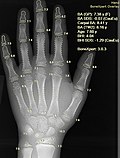 X-ray of hand, where bone age is automatically found by BoneXpert software
 -
 Elderly Man Using Pulse Oximeter
 -
 Ki67 calculation by QuPath in a pure seminoma
 -
 Elon Musk and the Neuralink Future
 -
 Workshop GDPR compliance at the 2019 Global Entrepreneurship Summit
 -
 Logo of the United States Food and Drug Administration


