Dispersive prism: Difference between revisions
CSV import Tags: mobile edit mobile web edit |
CSV import |
||
| Line 33: | Line 33: | ||
{{Optics-stub}} | {{Optics-stub}} | ||
<gallery> | |||
File:Light_dispersion_of_a_mercury-vapor_lamp_with_a_flint_glass_prism_IPNr°0125.jpg|Light dispersion of a mercury-vapor lamp with a flint glass prism | |||
File:Light_through_prism.jpg|Light through prism | |||
File:Light_dispersion_conceptual_waves.gif|Light dispersion conceptual waves | |||
File:Prism_ray_trace.svg|Prism ray trace | |||
File:Light_dispersion_of_a_mercury-vapor_lamp_with_a_flint_glass_prism_IPNr°0125.jpg|Light dispersion of a mercury-vapor lamp with a flint glass prism | |||
</gallery> | |||
Latest revision as of 11:30, 18 February 2025
Dispersive Prism
A dispersive prism is an optical device used to separate light into its constituent spectral colors (the colors of the rainbow). Prisms can be made from any transparent material with a non-zero dispersion, such as glass, plastic, or fluorite. The physical principle that allows a prism to disperse light is the dependence of the material's refractive index on the wavelength of light, a phenomenon known as dispersion.
Principle of Operation[edit]
The dispersive prism operates on the principle of Snell's law, which describes how light bends at the interface between two materials with different refractive indices. As light enters the prism, each wavelength is refracted at a different angle due to the wavelength-dependent refractive index of the prism material. This causes the light to spread out into a spectrum of colors upon exiting the prism. The most common shape for dispersive prisms is a triangular prism, which bends the light twice — upon entry and exit — enhancing the dispersion effect.
Types of Dispersive Prisms[edit]
Several types of dispersive prisms are used in optical applications, each with its unique geometry and dispersion characteristics. These include:
- Triangular Prisms: The simplest form of a dispersive prism, often used in educational settings to demonstrate light dispersion.
- Flint glass Prisms: Made from flint glass, these prisms have a high dispersion due to the material's high refractive index.
- Dove Prisms: Although not primarily used for dispersion, Dove prisms can disperse light when used in conjunction with other optical elements.
- Pellin-Broca Prisms: Designed to direct specific wavelengths of light at a fixed angle, making them useful in spectroscopy.
Applications[edit]
Dispersive prisms are utilized in a variety of applications, including:
- Spectroscopy: Prisms are essential components in spectrometers, devices that measure the spectrum of light sources.
- Optical Instruments: Prisms are used in binoculars, cameras, and telescopes to correct light paths and for color separation.
- Education: Demonstrating the principles of light dispersion and the visible spectrum.
Challenges and Considerations[edit]
While dispersive prisms are valuable tools in optics, they also present challenges. High dispersion can lead to chromatic aberration in imaging systems, where colors are not focused at the same point, leading to blurred images. Additionally, the efficiency of a prism in dispersing light depends on the material's properties and the light's angle of incidence, requiring careful design and alignment in optical systems.
See Also[edit]

-
 Light dispersion of a mercury-vapor lamp with a flint glass prism
 -
 Light through prism
 -
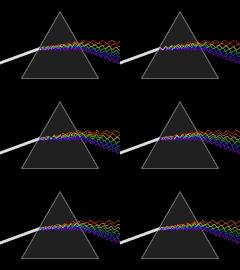 Light dispersion conceptual waves
 -
 Prism ray trace
 -
Light dispersion of a mercury-vapor lamp with a flint glass prism


