Floating airport: Difference between revisions
CSV import Tags: mobile edit mobile web edit |
CSV import |
||
| (One intermediate revision by the same user not shown) | |||
| Line 35: | Line 35: | ||
[[Category:Proposed infrastructure]] | [[Category:Proposed infrastructure]] | ||
{{aviation-stub}} | {{aviation-stub}} | ||
== Floating airport == | |||
<gallery> | |||
File:Floating_runway.jpeg | |||
File:Floating_runway_sunk.jpeg | |||
</gallery> | |||
== Floating_airport == | |||
<gallery> | |||
File:Floating_runway.jpeg|Floating runway | |||
File:Floating_runway_sunk.jpeg|Floating runway sunk | |||
</gallery> | |||
Latest revision as of 00:49, 18 February 2025
Floating Airport
A floating airport is a conceptual airport design that involves constructing runways and airport infrastructure on large platforms floating on water. Unlike traditional airports built on land, floating airports are designed to be situated on bodies of water such as oceans, seas, or large lakes. This innovative concept aims to address the challenges of land scarcity, environmental concerns, and the need for expansion in densely populated or geographically constrained areas.
Overview[edit]
The idea of floating airports has been proposed as a solution to the increasing demand for air travel and the subsequent need for more airport capacity. In cities where land is scarce or environmental and logistical constraints limit the expansion of existing airports, floating airports present a viable alternative. These structures are engineered to be robust and flexible, capable of withstanding harsh marine conditions, including strong currents, waves, and storms.
Design and Construction[edit]
The design of a floating airport typically involves the construction of a stable and durable platform that can support runways, taxiways, terminals, and other necessary airport infrastructure. Advanced materials and engineering techniques are employed to ensure the platform's buoyancy and stability. The construction of a floating airport requires careful consideration of marine engineering principles, environmental impact assessments, and integration with existing transportation networks.
Advantages[edit]
- Land Conservation: Floating airports do not require large tracts of land, helping to preserve natural landscapes and habitats.
- Flexibility: These airports can be expanded or reconfigured more easily than land-based airports by adding additional modules.
- Accessibility: Floating airports can be located closer to urban centers in coastal cities, potentially reducing travel time for passengers.
Challenges[edit]
- Environmental Impact: The construction and operation of floating airports may have significant impacts on marine ecosystems, including water quality and marine life.
- Engineering Complexity: Building a massive, stable structure on water presents numerous engineering challenges, including dealing with waves, tides, and corrosion.
- Cost: The innovative nature and technical requirements of floating airports can lead to higher construction and maintenance costs compared to traditional airports.
Examples[edit]
While the concept of floating airports is still largely theoretical, there have been proposals and feasibility studies for such projects in various parts of the world, including Japan's Kansai International Airport, which is built on an artificial island, and the proposed Thames Estuary Airport in the United Kingdom.
Future Prospects[edit]
As technology advances and the demand for air travel continues to grow, the concept of floating airports may become more feasible. Research and development in materials science, marine engineering, and environmental sustainability will play crucial roles in overcoming the current challenges associated with floating airports.
See Also[edit]

Floating airport[edit]


Floating_airport[edit]
-
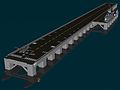 Floating runway
 -
 Floating runway sunk
