Fridericia chica: Difference between revisions
CSV import Tags: mobile edit mobile web edit |
CSV import |
||
| Line 25: | Line 25: | ||
[[Category:Flora of South America]] | [[Category:Flora of South America]] | ||
{{medicine-stub}} | {{medicine-stub}} | ||
<gallery> | |||
File:Flickr_-_João_de_Deus_Medeiros_-_Fridericia_chica.jpg|Fridericia chica flower | |||
File:Murachief.jpg|Fridericia chica | |||
</gallery> | |||
Latest revision as of 02:10, 18 February 2025
Fridericia chica (Bignoniaceae) is a species of flowering plant native to the tropical regions of South America, including the Amazon rainforest. It is commonly known as Chica, Crajiru, or Carajuru. This plant has been traditionally used by indigenous peoples for its medicinal properties and as a natural dye. The leaves, bark, and roots of Fridericia chica are utilized in various traditional medicine practices to treat a range of ailments.
Description[edit]
Fridericia chica is a climbing shrub that can reach up to several meters in height. It has compound leaves and produces clusters of vibrant red or pink flowers, which are followed by fruit in the form of elongated capsules containing winged seeds. The plant's distinctive coloration is due to the presence of pigments known as anthocyanins, which have been studied for their potential health benefits.
Traditional Uses[edit]
Traditionally, Fridericia chica has been used by indigenous communities for its healing properties. The leaves, when crushed, produce a red pigment that has been used for body painting, as a fabric dye, and in rituals. Medicinally, it has been used to treat skin conditions, wounds, and as an anti-inflammatory agent. Infusions made from the leaves or bark are used to treat gastrointestinal issues, fevers, and as a general tonic.
Phytochemistry[edit]
The phytochemical analysis of Fridericia chica has revealed the presence of a variety of bioactive compounds, including flavonoids, tannins, and anthocyanins. These compounds are believed to contribute to the plant's medicinal properties, offering antioxidant, anti-inflammatory, and antimicrobial effects.
Research and Potential Health Benefits[edit]
Recent scientific research has focused on investigating the potential health benefits of Fridericia chica. Studies have explored its antioxidant capacity, its role in wound healing, and its effects on various diseases. While promising, much of this research is still in the early stages, and more studies are needed to fully understand the medicinal potential of this plant.
Conservation[edit]
As with many plants native to the Amazon rainforest, Fridericia chica faces threats from deforestation and habitat destruction. Efforts to conserve its natural habitat are crucial for ensuring its survival and the continuation of the traditional knowledge associated with its use.
See Also[edit]

-
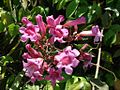 Fridericia chica flower
 -
 Fridericia chica


