C-terminus: Difference between revisions
CSV import Tags: mobile edit mobile web edit |
CSV import |
||
| Line 33: | Line 33: | ||
[[Category:Biochemistry]] | [[Category:Biochemistry]] | ||
{{medicine-stub}} | {{medicine-stub}} | ||
<gallery> | |||
File:Tetrapeptide_structural_formulae_v.1.png|C-terminus | |||
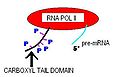
File:ARN_pol_II_en_accion.jpg|C-terminus | |||
</gallery> | |||
Latest revision as of 01:37, 18 February 2025
C-terminus or carboxyl-terminus is a term used in protein biology to refer to the end of an amino acid chain (polypeptide) which terminates in a free carboxyl group (-COOH). Proteins are synthesized by ribosomes in a process known as translation, where messenger RNA (mRNA) is decoded to produce a specific sequence of amino acids. The C-terminus is the end of the amino acid chain that is synthesized last, opposite to the N-terminus, which contains a free amino group (-NH2) and is synthesized first. The sequence of the protein is always read from the N-terminus to the C-terminus, reflecting the direction of synthesis and the orientation of the protein's primary structure.
Structure and Function[edit]
The structure of the C-terminus can influence the protein's stability, localization, and interaction with other molecules. For example, specific sequences at the C-terminus can act as signal peptides, directing the protein to specific locations within the cell, such as the nucleus, mitochondria, or endoplasmic reticulum. Additionally, the C-terminus can participate in the regulation of protein activity through post-translational modifications such as phosphorylation, ubiquitination, and acetylation. These modifications can affect the protein's function, its interactions with other proteins, and its degradation.
Post-Translational Modifications[edit]
Post-translational modifications (PTMs) at the C-terminus play critical roles in the regulation of protein function. For instance:
- Phosphorylation: The addition of a phosphate group, often modulates the activity of enzymes and signaling proteins. - Ubiquitination: The attachment of ubiquitin molecules, targeting the protein for degradation by the proteasome. - Acetylation: The addition of an acetyl group, can influence protein stability and interactions with other molecules.
C-Terminal Sequences and Targeting Signals[edit]
Certain C-terminal sequences act as targeting signals, directing the protein to its appropriate location within the cell. These include:
- Nuclear Localization Signals (NLS): Direct proteins to the nucleus. - Mitochondrial Targeting Sequences (MTS): Guide proteins to the mitochondria. - ER Retention Signals: Retain proteins in the endoplasmic reticulum.
Clinical Significance[edit]
Alterations in the C-terminus of proteins can lead to diseases. For example, mutations that affect the C-terminal targeting signals can result in mislocalization of proteins, contributing to the pathology of various diseases, including cancer and neurodegenerative diseases. Furthermore, the C-terminus is a target for the development of therapeutic agents, as modulating the interactions or modifications at this site can influence the activity and stability of pathologically relevant proteins.
Research Tools[edit]
In research, synthetic peptides corresponding to the C-terminal sequences of proteins are often used as tools for studying protein-protein interactions, as well as for the development of antibodies that specifically recognize the C-terminus of proteins.
See Also[edit]

-
 C-terminus
 -
 C-terminus


