Complications of hypertension: Difference between revisions
CSV import Tags: mobile edit mobile web edit |
CSV import |
||
| Line 38: | Line 38: | ||
[[Category:Medical conditions related to obesity]] | [[Category:Medical conditions related to obesity]] | ||
[[Category:Hypertension]] | [[Category:Hypertension]] | ||
<gallery> | |||
File:Main_complications_of_persistent_high_blood_pressure.svg|Main complications of persistent high blood pressure | |||
File:Heart_left_ventricular_hypertrophy_sa.jpg|Heart left ventricular hypertrophy | |||
File:Hypertensiveretinopathy.jpg|Hypertensive retinopathy | |||
</gallery> | |||
Latest revision as of 05:03, 18 February 2025
Complications of Hypertension
Hypertension, commonly known as high blood pressure, is a chronic medical condition in which the blood pressure in the arteries is persistently elevated. This condition is a primary risk factor for numerous cardiovascular and renal diseases, making the understanding of its complications crucial for both patients and healthcare providers. This article aims to provide a comprehensive overview of the complications associated with hypertension, emphasizing the importance of early detection, management, and prevention strategies.
Cardiovascular Complications[edit]
Hypertension can lead to a range of cardiovascular complications due to the increased workload on the heart and blood vessels, leading to their structural and functional alterations. These include:
- Coronary artery disease (CAD): Hypertension can cause the narrowing of the arteries that supply blood to the heart muscle, leading to chest pain (angina), myocardial infarction, and other CAD complications.
- Heart failure: High blood pressure can weaken the heart muscle over time, impairing its ability to pump blood efficiently, which can result in heart failure.
- Left ventricular hypertrophy (LVH): This condition involves the thickening of the heart's left ventricle, which can impair the heart's function and increase the risk of heart failure and sudden cardiac death.
- Arrhythmias: Hypertension can lead to abnormal heart rhythms, which can cause palpitations, dizziness, fainting, or even sudden death.
Cerebrovascular Complications[edit]
Hypertension is a leading risk factor for cerebrovascular diseases, which affect the blood vessels that supply the brain:
- Stroke: Elevated blood pressure can cause both ischemic and hemorrhagic strokes by either blocking or rupturing cerebral arteries, respectively. Strokes can lead to significant disability or death.
- Transient ischemic attack (TIA): Often referred to as a "mini-stroke," a TIA is a temporary blockage of blood flow to the brain, serving as a warning sign for a potential future stroke.
Renal Complications[edit]
The kidneys are another organ system profoundly affected by hypertension, as they rely on a dense network of blood vessels for filtration:
- Chronic kidney disease (CKD): Hypertension can damage the blood vessels in the kidneys, reducing their ability to filter waste from the blood effectively, which can progress to CKD.
- End-stage renal disease (ESRD): This is the most severe form of CKD, where the kidneys have failed, and dialysis or a kidney transplant is required to sustain life.
Peripheral Arterial Disease[edit]
Hypertension can cause peripheral arterial disease (PAD), a condition characterized by the narrowing of peripheral arteries, most commonly in the legs, leading to pain, cramping, and reduced mobility.
Ocular Complications[edit]
The eyes can also suffer from the effects of hypertension, as it can damage the delicate blood vessels in the retina, leading to:
- Hypertensive retinopathy: This condition can cause blurred vision, retinal hemorrhage, and, in severe cases, blindness.
Management and Prevention[edit]
Managing hypertension involves lifestyle modifications, such as adopting a healthy diet, regular physical activity, maintaining a healthy weight, and limiting alcohol intake. Medications may also be prescribed to help lower blood pressure. Early detection and effective management of hypertension are critical to preventing or mitigating its complications.
-
 Main complications of persistent high blood pressure
 -
 Heart left ventricular hypertrophy
 -
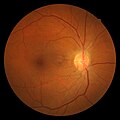 Hypertensive retinopathy


