Curing (chemistry): Difference between revisions
CSV import |
CSV import |
||
| Line 32: | Line 32: | ||
{{chemistry-stub}} | {{chemistry-stub}} | ||
{{medicine-stub}} | {{medicine-stub}} | ||
<gallery> | |||
File:VernetzteEpoxidharze.svg|Vernetzte Epoxidharze | |||
File:Vulcanization of POLYIsoprene V.2.png|Vulcanization of POLYIsoprene | |||
File:Moduli vs Time cuirng reaction - 2019-07-03 - TB.png|Moduli vs Time curing reaction | |||
</gallery> | |||
Latest revision as of 06:20, 3 March 2025
Curing (chemistry)
Curing (chemistry) is a chemical process employed in polymer chemistry and process engineering that produces the toughening or hardening of a polymer material by cross-linking of polymer chains. This is brought about by chemical additives, ultraviolet radiation, electron beam or heat.
Process[edit]
Curing can be initiated by heat, humidity, radiation, electron beams, or chemical additives. The process involves the formation of long-chain polymer chains. These polymers are then cross-linked to create a three-dimensional network of connected molecules. The resulting material is resistant to deformation and has improved physical properties.
Applications[edit]
Curing processes are widely used in the production of composite materials, adhesives, paints, varnishes, and rubber. In the case of thermosetting polymers, curing is an irreversible process as it sets the polymer into a solid shape that cannot be re-melted or reformed.
Curing Agents[edit]
Curing agents are substances that promote or control the curing process by taking part in it. The choice of curing agent can significantly affect the physical properties of the cured polymer, the curing rate, and the nature of the chemical reactions that take place.
See Also[edit]


-
 Vernetzte Epoxidharze
 -
 Vulcanization of POLYIsoprene
 -
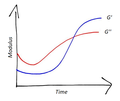 Moduli vs Time curing reaction


