TASB (psychedelics): Difference between revisions
CSV import |
CSV import |
||
| Line 34: | Line 34: | ||
{{pharmacology-stub}} | {{pharmacology-stub}} | ||
<gallery> | |||
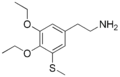
File:3-TASB.png|3-TASB | |||
File:4-TASB.png|4-TASB | |||
File:5-TASB.png|5-TASB | |||
</gallery> | |||
Latest revision as of 01:21, 18 February 2025
TASB (psychedelics)
TASB is a class of psychedelic drugs that are known for their ability to induce profound changes in consciousness. The term TASB is an acronym for 2,5-dimethoxy-4-alkylthiophenethylamines, a family of compounds that includes several individual substances, each with its own unique effects and uses.
Chemistry[edit]
TASB compounds are phenethylamines, a broad class of chemicals that also includes well-known substances like mescaline and amphetamine. They are characterized by a phenethylamine core, which is a structure composed of a phenyl ring bound to an amino (NH2) group through an ethyl chain. The TASB compounds are distinguished by the presence of a sulfur atom in the 4-position of the phenyl ring, which is thought to contribute to their unique psychedelic effects.
Pharmacology[edit]
The exact mechanisms of action of TASB compounds are not fully understood, but they are believed to work primarily by acting as agonists at the 5-HT2A receptor, a subtype of the serotonin receptor. This is the same mechanism of action shared by other classic psychedelics like LSD and psilocybin.
Effects[edit]
The effects of TASB compounds can vary widely depending on the specific substance and the dose used. However, common effects reported by users include visual hallucinations, altered thought processes, enhanced empathy and emotional openness, and a sense of spiritual or mystical experience.
Safety[edit]
Like all psychedelic drugs, TASB compounds carry risks. These can include psychological distress, dangerous behavior due to impaired judgment, and potential for abuse. It is important for users to be aware of these risks and to use these substances responsibly.
Legal Status[edit]
The legal status of TASB compounds varies by country and by specific substance. In many jurisdictions, they are classified as controlled substances and their manufacture, sale, or possession can be subject to legal penalties.
See Also[edit]

-
 3-TASB
 -
 4-TASB
 -
 5-TASB


