Intravesical drug delivery: Difference between revisions
CSV import |
CSV import Tags: mobile edit mobile web edit |
||
| Line 26: | Line 26: | ||
{{pharmacology-stub}} | {{pharmacology-stub}} | ||
== Intravesical_drug_delivery == | |||
<gallery> | |||
File:Intravesical_Drug_Delivery.png|Intravesical drug delivery | |||
File:Urothelium_Layers.png|Urothelium layers | |||
File:Mucoadhesive_delivered_to_the_bladder_wall.png|Mucoadhesive delivered to the bladder wall | |||
File:Electromotive_Drug_Administration.png|Electromotive drug administration | |||
</gallery> | |||
Latest revision as of 04:36, 18 February 2025
Intravesical Drug Delivery is a medical procedure that involves the direct administration of pharmaceutical agents into the bladder for therapeutic purposes. This method is primarily used in the treatment of bladder diseases, including bladder cancer and interstitial cystitis.
Overview[edit]
Intravesical drug delivery is a localized form of drug administration that allows for high concentrations of the drug to be delivered directly to the target site, minimizing systemic side effects. This method is particularly beneficial in the treatment of bladder diseases, where systemic administration of drugs may not achieve therapeutic concentrations in the bladder due to the organ's unique barrier properties.
Procedure[edit]
The procedure involves the insertion of a catheter into the bladder through the urethra. The drug solution is then instilled into the bladder and retained for a specified period, typically one to two hours, to allow for optimal absorption of the drug into the bladder wall. The solution is then voided or drained out through the catheter.
Drugs Used[edit]
Several drugs can be administered intravesically, including chemotherapy agents such as Mitomycin C and Bacillus Calmette-Guérin (BCG), an immunotherapy agent. Other drugs used include Dimethyl sulfoxide (DMSO) for interstitial cystitis and Botulinum toxin for overactive bladder.
Advantages and Disadvantages[edit]
The main advantage of intravesical drug delivery is the ability to deliver high concentrations of the drug directly to the target site, minimizing systemic side effects. However, the procedure can be uncomfortable and may cause side effects such as bladder irritation and urinary tract infections.
Future Directions[edit]
Research is ongoing to improve the efficacy and tolerability of intravesical drug delivery. This includes the development of new drug formulations and delivery systems, such as nanoparticles and hydrogels, to enhance drug absorption and retention in the bladder.

Intravesical_drug_delivery[edit]
-
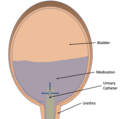 Intravesical drug delivery
 -
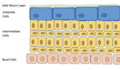 Urothelium layers
 -
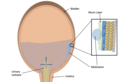 Mucoadhesive delivered to the bladder wall
 -
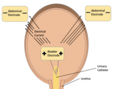 Electromotive drug administration


