Ionotropic GABA receptor: Difference between revisions
CSV import Tags: mobile edit mobile web edit |
CSV import |
||
| Line 29: | Line 29: | ||
{{pharmacology-stub}} | {{pharmacology-stub}} | ||
<gallery> | |||
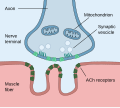
File:Neuromuscular_junction.svg|Ionotropic GABA receptor | |||
File:Classification_of_Ligand-Gated_Ion_Channels_2.jpg|Ionotropic GABA receptor | |||
</gallery> | |||
Latest revision as of 01:58, 18 February 2025
Ionotropic GABA receptors are a class of GABA receptors that function as ligand-gated ion channels. They are activated by the neurotransmitter gamma-aminobutyric acid (GABA), which is the primary inhibitory neurotransmitter in the central nervous system.
Structure[edit]
Ionotropic GABA receptors are composed of five subunits that form a central pore, which is permeable to chloride ions. The subunits are drawn from a pool of 19 different types, and the combination of subunits determines the properties of the receptor. The most common type of ionotropic GABA receptor is the GABAA receptor.
Function[edit]
When GABA binds to an ionotropic GABA receptor, it causes the receptor to open its central pore, allowing chloride ions to flow into the cell. This influx of chloride ions hyperpolarizes the cell, making it less likely to fire an action potential. This inhibitory effect helps to balance the excitatory activity of other neurotransmitters, such as glutamate.
Clinical significance[edit]
Ionotropic GABA receptors are the target of several classes of drugs, including benzodiazepines, barbiturates, and alcohol. These drugs enhance the effect of GABA at the receptor, leading to increased inhibitory activity in the brain. This can have a range of effects, from reducing anxiety and promoting sleep to causing sedation and loss of consciousness.
See also[edit]
References[edit]
<references />

-
 Ionotropic GABA receptor
 -
 Ionotropic GABA receptor


