Hydroxylation of estradiol: Difference between revisions
CSV import Tags: mobile edit mobile web edit |
CSV import |
||
| Line 28: | Line 28: | ||
{{endocrinology-stub}} | {{endocrinology-stub}} | ||
{{pharmacology-stub}} | {{pharmacology-stub}} | ||
<gallery> | |||
File:CYP-mediated_biosynthesis_and_metabolism_of_estradiol.png|CYP-mediated biosynthesis and metabolism of estradiol | |||
File:4OHE2_metabolism.png|4OHE2 metabolism | |||
</gallery> | |||
Latest revision as of 01:49, 18 February 2025
Hydroxylation of Estradiol
The Hydroxylation of Estradiol is a biochemical process that involves the addition of a hydroxyl group (-OH) to the estradiol molecule. This process is catalyzed by enzymes known as cytochrome P450 enzymes, specifically the CYP1A1, CYP1A2, and CYP1B1 isoforms. The hydroxylation of estradiol results in the formation of hydroxylated metabolites, which have different biological activities compared to the parent estradiol molecule.
Process[edit]
The hydroxylation of estradiol occurs primarily at two positions on the estradiol molecule: the 2-position and the 16-position. The 2-hydroxylation of estradiol produces 2-hydroxyestradiol, while the 16-hydroxylation of estradiol produces 16α-hydroxyestrone. These hydroxylated metabolites are then further metabolized by other enzymes, such as sulfotransferases and glucuronosyltransferases, to form conjugated metabolites that can be excreted from the body.
Biological Significance[edit]
The hydroxylation of estradiol has significant biological implications. The hydroxylated metabolites of estradiol have different biological activities compared to the parent estradiol molecule. For example, 2-hydroxyestradiol has weak estrogenic activity, while 16α-hydroxyestrone has potent estrogenic activity. The balance between these two metabolites can influence the overall estrogenic activity in the body, and has been implicated in the development of estrogen-dependent diseases such as breast cancer and endometriosis.
Clinical Significance[edit]
The hydroxylation of estradiol is also of clinical significance. The activity of the cytochrome P450 enzymes that catalyze this process can be influenced by various factors, including genetic polymorphisms, environmental exposures, and certain medications. Alterations in the activity of these enzymes can affect the balance of estradiol metabolites in the body, potentially influencing the risk of developing estrogen-dependent diseases. Furthermore, the measurement of estradiol metabolites in biological samples can be used as a biomarker for assessing individual differences in estrogen metabolism.
See Also[edit]
.svg)
This article is a biochemistry stub. You can help WikiMD by expanding it!

This article is a endocrinology stub. You can help WikiMD by expanding it!

-
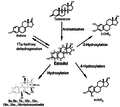 CYP-mediated biosynthesis and metabolism of estradiol
 -
 4OHE2 metabolism


