Verbena officinalis: Difference between revisions
CSV import |
CSV import |
||
| (3 intermediate revisions by the same user not shown) | |||
| Line 1: | Line 1: | ||
{{Short description|Species of flowering plant in the verbena family}} | |||
[[File:Verbena_officinalis_sl2.jpg|''Verbena officinalis'' in bloom|thumb|right]] | |||
Verbena | |||
'''Verbena officinalis''', commonly known as common vervain or simpler's joy, is a perennial herbaceous plant in the family [[Verbenaceae]]. It is native to Europe, North Africa, and parts of Asia, but has been introduced to the Americas and other regions. This plant is known for its historical use in herbal medicine and its role in various cultural traditions. | |||
Verbena | |||
== | ==Description== | ||
Verbena | ''Verbena officinalis'' is a slender, erect plant that typically grows to a height of 30 to 100 cm. The stems are square in cross-section, a characteristic feature of the [[Lamiaceae]] family, to which it is closely related. The leaves are opposite, oblong to lanceolate, and deeply lobed, giving them a somewhat feathery appearance. | ||
The flowers of ''Verbena officinalis'' are small, pale lilac or pink, and are arranged in slender spikes. Each flower is tubular with five lobes, and they bloom from mid-summer to early autumn. The plant produces small, dry fruits known as schizocarps, which split into four nutlets when mature. | |||
Verbena | |||
== | ==Habitat== | ||
Verbena | ''Verbena officinalis'' thrives in a variety of habitats, including grasslands, roadsides, and waste areas. It prefers well-drained soils and can often be found in sunny locations. The plant is tolerant of drought and poor soil conditions, which contributes to its widespread distribution. | ||
== | ==Uses== | ||
Historically, ''Verbena officinalis'' has been used in traditional medicine for its purported healing properties. It has been employed as a remedy for headaches, insomnia, and digestive disorders. The plant is also associated with various magical and religious practices, often considered a sacred herb in ancient cultures. | |||
In modern herbal medicine, ''Verbena officinalis'' is sometimes used as a mild sedative and for its anti-inflammatory properties. However, scientific evidence supporting these uses is limited, and it should be used with caution. | |||
==Cultural Significance== | |||
[[File:Hierabotane_Verbenaca.jpg|Illustration of ''Verbena officinalis''|thumb|left]] | |||
In ancient Roman and Greek cultures, ''Verbena officinalis'' was considered a sacred plant, often used in religious ceremonies and rituals. It was believed to have protective and purifying properties, and was sometimes used to ward off evil spirits. | |||
The plant's association with magic and healing has persisted through the ages, and it is often mentioned in folklore and literature. In some traditions, it is used in love potions and as a charm for good luck. | |||
==Related pages== | |||
* [[Verbenaceae]] | * [[Verbenaceae]] | ||
* [[ | * [[Herbal medicine]] | ||
* [[ | * [[Perennial plant]] | ||
== | ==Gallery== | ||
< | <gallery> | ||
File:Verbena_officinalis_sl2.jpg|''Verbena officinalis'' | |||
File:Hierabotane_Verbenaca.jpg|''Verbena officinalis'' | |||
</gallery> | |||
{{Taxonbar|from=Q157303}} | |||
[[Category:Verbenaceae]] | [[Category:Verbenaceae]] | ||
[[Category:Flora of Europe]] | |||
[[Category:Flora of Asia]] | |||
[[Category:Herbs]] | |||
Latest revision as of 18:46, 23 March 2025
Species of flowering plant in the verbena family

Verbena officinalis, commonly known as common vervain or simpler's joy, is a perennial herbaceous plant in the family Verbenaceae. It is native to Europe, North Africa, and parts of Asia, but has been introduced to the Americas and other regions. This plant is known for its historical use in herbal medicine and its role in various cultural traditions.
Description[edit]
Verbena officinalis is a slender, erect plant that typically grows to a height of 30 to 100 cm. The stems are square in cross-section, a characteristic feature of the Lamiaceae family, to which it is closely related. The leaves are opposite, oblong to lanceolate, and deeply lobed, giving them a somewhat feathery appearance.
The flowers of Verbena officinalis are small, pale lilac or pink, and are arranged in slender spikes. Each flower is tubular with five lobes, and they bloom from mid-summer to early autumn. The plant produces small, dry fruits known as schizocarps, which split into four nutlets when mature.
Habitat[edit]
Verbena officinalis thrives in a variety of habitats, including grasslands, roadsides, and waste areas. It prefers well-drained soils and can often be found in sunny locations. The plant is tolerant of drought and poor soil conditions, which contributes to its widespread distribution.
Uses[edit]
Historically, Verbena officinalis has been used in traditional medicine for its purported healing properties. It has been employed as a remedy for headaches, insomnia, and digestive disorders. The plant is also associated with various magical and religious practices, often considered a sacred herb in ancient cultures.
In modern herbal medicine, Verbena officinalis is sometimes used as a mild sedative and for its anti-inflammatory properties. However, scientific evidence supporting these uses is limited, and it should be used with caution.
Cultural Significance[edit]

In ancient Roman and Greek cultures, Verbena officinalis was considered a sacred plant, often used in religious ceremonies and rituals. It was believed to have protective and purifying properties, and was sometimes used to ward off evil spirits.
The plant's association with magic and healing has persisted through the ages, and it is often mentioned in folklore and literature. In some traditions, it is used in love potions and as a charm for good luck.
Related pages[edit]
Gallery[edit]
-
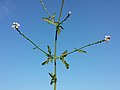 Verbena officinalis
 -
 Verbena officinalis
