Tilia cordata: Difference between revisions
CSV import |
CSV import |
||
| Line 26: | Line 26: | ||
{{trees-stub}} | {{trees-stub}} | ||
{{medicinal-plants-stub}} | {{medicinal-plants-stub}} | ||
<gallery> | |||
File:Tilia-cordata2.JPG|Tilia cordata | |||
File:Bombus_hypnorum_-_Tilia_cordata_-_Keila.jpg|Bombus hypnorum on Tilia cordata | |||
File:Tilia_platyphyllos_and_T._cordata_leaf_comparison.jpg|Tilia platyphyllos and Tilia cordata leaf comparison | |||
File:Tilia_cordata,_Small-leaved_Lime,_Cowlairs,_Glasgow.jpg|Tilia cordata, Small-leaved Lime, Cowlairs, Glasgow | |||
File:Tilia_cordata_pollen.jpg|Tilia cordata pollen | |||
File:Tilleul,_Haute-Savoie,_France.jpg|Tilleul, Haute-Savoie, France | |||
File:Heilbronn_-_Kirchhausen_-_St.-Anna-Linde_-_Ansicht_von_NNW_im_Juni.jpg|Heilbronn - Kirchhausen - St. Anna Linde - Ansicht von NNW im Juni | |||
File:Tilia_cordata_MHNT.BOT.2004.0.780.jpg|Tilia cordata MHNT.BOT.2004.0.780 | |||
File:Tiliae_flos_dried.jpg|Tiliae flos dried | |||
File:COA_LV_Valmiera.svg|COA LV Valmiera | |||
</gallery> | |||
Latest revision as of 10:56, 18 February 2025
Tilia cordata, also known as the Small-leaved Lime, is a species of Tilia native to much of Europe. It is found from Britain through mainland Europe to the Caucasus and western Asia. In the south of its range, it is confined to high altitudes.
Description[edit]
Tilia cordata is a deciduous tree growing to 20–40 m (66–131 ft) tall, with a trunk up to 1 m diameter. The leaves are alternately arranged, rounded to triangular-ovate, 3–8 cm long and broad, mostly hairless (unlike the related Tilia platyphyllos) except for small tufts of brown hair in the leaf vein axils.
Cultivation and uses[edit]
The tree is widely cultivated for its attractive foliage and fragrant flowers. The flowers are used for herbal tea and for medicinal purposes. The wood is used for carving and for making musical instruments and sports equipment.
Ecology[edit]
Tilia cordata is a food plant for the caterpillars of many Lepidoptera species. The flowers are also very attractive to bees and other insects.
Conservation[edit]
Although Tilia cordata is not currently considered threatened, it has declined in many areas due to habitat loss and pollution.
References[edit]
<references />
See also[edit]
This tree-related article is a stub. You can help WikiMD by expanding it.
This medicinal plants related article is a stub. You can help WikiMD by expanding it.
-
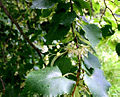 Tilia cordata
 -
 Bombus hypnorum on Tilia cordata
 -
 Tilia platyphyllos and Tilia cordata leaf comparison
 -
 Tilia cordata, Small-leaved Lime, Cowlairs, Glasgow
 -
 Tilia cordata pollen
 -
 Tilleul, Haute-Savoie, France
 -
 Heilbronn - Kirchhausen - St. Anna Linde - Ansicht von NNW im Juni
 -
 Tilia cordata MHNT.BOT.2004.0.780
 -
 Tiliae flos dried
 -
 COA LV Valmiera


