Stachys byzantina: Difference between revisions
CSV import |
CSV import |
||
| Line 24: | Line 24: | ||
[[Category:Perennial plants]] | [[Category:Perennial plants]] | ||
{{Lamiaceae-stub}} | {{Lamiaceae-stub}} | ||
== Stachys_byzantina == | |||
<gallery> | |||
File:0_Stachys_byzantina_-_Yvoire_(2).JPG|Stachys byzantina in Yvoire | |||
File:Lamb's_ear.jpg|Lamb's ear | |||
File:Lamb's_Ear_Stachys_byzantina_Leaves_3264px.JPG|Lamb's Ear Stachys byzantina Leaves | |||
File:Lamb's_Ear_Stachys_byzantina_Leaf_2448px.jpg|Lamb's Ear Stachys byzantina Leaf | |||
File:Lamb's-ears_Betony_Stachys_byzantina_Plant_2800px.jpg|Lamb's-ears Betony Stachys byzantina Plant | |||
File:StachysByzantina.jpg|Stachys byzantina | |||
File:Lampaankorva.jpg|Lampaankorva | |||
File:Gardenology.org-IMG_2743_rbgs11jan.jpg|Stachys byzantina | |||
</gallery> | |||
Latest revision as of 11:44, 18 February 2025
Stachys byzantina is a species of perennial plant in the Lamiaceae family, commonly known as Lamb's Ear due to its soft, fuzzy leaves. It is native to Turkey, Armenia, and Iran, but has been widely cultivated in many other regions, including North America and Europe.
Description[edit]
Stachys byzantina is a low-growing, spreading plant typically reaching 10-50 cm in height. Its most distinctive feature is its leaves, which are densely covered in silvery-white, woolly hairs. The leaves are usually 5-10 cm long and 3-6 cm wide, and are arranged in a rosette at the base of the plant. The flowers are small, purple or pink, and are borne in spikes in the summer.
Cultivation[edit]
Stachys byzantina is a popular plant in ornamental gardening due to its unique texture and low maintenance requirements. It prefers full sun to partial shade and well-drained soil. It is drought-tolerant once established and can tolerate poor soil conditions. It is often used as a ground cover, in rock gardens, or as an edging plant.
Uses[edit]
In addition to its use in gardening, Stachys byzantina has also been used in traditional medicine. The leaves have been used to treat minor wounds and burns due to their soft texture and purported antibacterial properties.
Taxonomy[edit]
The species was first described by botanist Pierre Edmond Boissier in 1842. The genus name Stachys comes from the Greek word for "spike", referring to the shape of the flower arrangement, while the species name byzantina refers to the plant's origin in the Byzantine Empire.
See also[edit]

Stachys_byzantina[edit]
-
 Stachys byzantina in Yvoire
 -
 Lamb's ear
 -
 Lamb's Ear Stachys byzantina Leaves
 -
 Lamb's Ear Stachys byzantina Leaf
 -
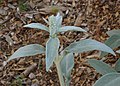 Lamb's-ears Betony Stachys byzantina Plant
 -
 Stachys byzantina
 -
 Lampaankorva
 -
 Stachys byzantina
.JPG)


