Smyrnium olusatrum: Difference between revisions
CSV import |
CSV import |
||
| Line 25: | Line 25: | ||
[[Category:Culinary herbs and spices]] | [[Category:Culinary herbs and spices]] | ||
{{Flora-stub}} | {{Flora-stub}} | ||
<gallery> | |||
File:Smyrnium_olusatrum_kz07.jpg|Smyrnium olusatrum | |||
File:Smyrnium_olusatrum_lateral_umbel.jpg|Lateral umbel of Smyrnium olusatrum | |||
File:Smyrnium_olusatrum_carpophore.jpg|Carpophore of Smyrnium olusatrum | |||
File:Smyrnium_olusatrum_distribution_map.svg|Distribution map of Smyrnium olusatrum | |||
File:Smyrnium_olusatrum_blisters.jpg|Blisters on Smyrnium olusatrum | |||
File:Smyrnium_olusatrum_mines.jpg|Mines on Smyrnium olusatrum | |||
File:Smyrnium_olusatrum_seeds.jpg|Seeds of Smyrnium olusatrum | |||
</gallery> | |||
Latest revision as of 10:54, 18 February 2025
Smyrnium olusatrum, also known as Alexanders, Black Lovage, or Horse Parsley, is a flowering plant in the family Apiaceae. It is native to the Mediterranean region but has been naturalized in many other parts of the world.
Description[edit]
Smyrnium olusatrum is a biennial or short-lived perennial plant growing up to 150 cm tall. The leaves are tripinnate, broad, and oval with a white, waxy coating. The flowers are yellow-green, produced in dense umbels, and the fruit is a small black schizocarp.
Distribution and habitat[edit]
Smyrnium olusatrum is native to the Mediterranean region but has been naturalized in many other parts of the world, including the British Isles, Australia, and North America. It grows in a variety of habitats, including coastal areas, riverbanks, and waste ground.
Uses[edit]
Smyrnium olusatrum has a long history of use as a culinary herb. The leaves, stems, and seeds can all be used in cooking, and have a flavor similar to celery. In the past, it was cultivated as a vegetable, but it has largely fallen out of use in modern times.
Cultivation[edit]
Smyrnium olusatrum is a hardy plant that can grow in a variety of conditions. It prefers well-drained soil and a sunny or partially shaded location. It can be propagated by seed, which should be sown in spring or autumn.
See also[edit]
References[edit]
<references />

This flora-related article is a stub. You can help WikiMD by expanding it.
-
 Smyrnium olusatrum
 -
 Lateral umbel of Smyrnium olusatrum
 -
 Carpophore of Smyrnium olusatrum
 -
 Distribution map of Smyrnium olusatrum
 -
 Blisters on Smyrnium olusatrum
 -
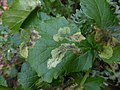 Mines on Smyrnium olusatrum
 -
 Seeds of Smyrnium olusatrum


