Partial veil: Difference between revisions
CSV import |
CSV import |
||
| Line 30: | Line 30: | ||
[[Category:Mushrooms]] | [[Category:Mushrooms]] | ||
{{mycology-stub}} | {{mycology-stub}} | ||
<gallery> | |||
File:1797-09-03_Agaricus_campestris_Plate_by_James_Sowerby.jpg|Agaricus campestris illustration by James Sowerby | |||
File:Stropharia_ambigua_128520.jpg|Stropharia ambigua | |||
File:Stropharia_ambigua_123137.jpg|Stropharia ambigua | |||
File:Unidentified_Fungi_5974_2.jpg|Partial_veil | |||
File:Cortinarius_claricolor_01.jpg|Cortinarius claricolor | |||
File:Basidioma_agaric_veils.png|Basidioma agaric veils | |||
</gallery> | |||
Latest revision as of 11:02, 18 February 2025
Partial Veil
A partial veil is a significant feature in the morphology of a mushroom. It is a temporary structure of tissue found on the fruiting bodies of some Basidiomycota and Ascomycota species. The partial veil, also known as a cortina or inner veil, serves to protect the developing spore-producing surface, known as the hymenium, of the mushroom.
Function[edit]
The primary function of the partial veil is to shield the young spore-producing cells from damage. As the mushroom matures, the veil breaks away, revealing the mature hymenium. The remnants of the partial veil may remain on the stipe or the cap of the mushroom, often forming a ring or an annulus.
Types of Partial Veils[edit]
There are several types of partial veils, including:
- Cortina: A cobweb-like veil found in some species of the Cortinarius and Inocybe genera.
- Velum or Universal Veil: A membrane that completely covers immature fruiting bodies in some mushroom species, such as Amanita.
- Annulus: The ring-like structure that remains on the stipe after the partial veil breaks away.
Identification[edit]
The presence and characteristics of a partial veil can be crucial in the identification of mushroom species. For instance, the presence of a cortina is a key identifying feature of the Cortinarius genus. Similarly, the presence of a universal veil and the resulting warts or patches on the cap are characteristic of the Amanita genus.
See Also[edit]

-
 Agaricus campestris illustration by James Sowerby
 -
 Stropharia ambigua
 -
 Stropharia ambigua
 -
 Partial_veil
 -
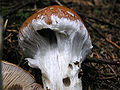 Cortinarius claricolor
 -
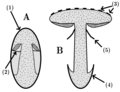 Basidioma agaric veils


