Oenanthe crocata: Difference between revisions
CSV import Tags: mobile edit mobile web edit |
CSV import |
||
| (2 intermediate revisions by the same user not shown) | |||
| Line 1: | Line 1: | ||
'''Oenanthe crocata''', | == Oenanthe crocata == | ||
[[File:Oenanthe_crocata_kz04.jpg|thumb|right|Oenanthe crocata in its natural habitat]] | |||
'''Oenanthe crocata''', commonly known as '''hemlock water-dropwort''', is a highly toxic plant native to Europe. It belongs to the [[Apiaceae]] family, which includes other well-known plants such as [[carrot]]s and [[parsley]]. | |||
== Description == | == Description == | ||
== | [[File:Oenanthe_crocata_leaflets.jpg|thumb|left|Leaflets of Oenanthe crocata]] | ||
Oenanthe crocata is a perennial herbaceous plant that can grow up to 1.5 meters tall. It has hollow stems and a distinctive yellowish sap. The leaves are pinnate with broad, toothed leaflets. | |||
=== Flowers === | |||
[[File:Oenanthe_crocata_flowers.jpg|thumb|right|Flowers of Oenanthe crocata]] | |||
The plant produces small, white flowers arranged in compound umbels. Each umbel consists of numerous tiny flowers, which are attractive to various pollinators. | |||
=== Fruit === | |||
[[File:Oenanthe_crocata_fruiting_umbel.jpg|thumb|left|Fruiting umbel of Oenanthe crocata]] | |||
The fruit of Oenanthe crocata is a schizocarp, which splits into two mericarps when mature. These fruits are an important identifying feature of the plant. | |||
== Habitat == | |||
[[File:Oenanthe_crocata_sward_at_Marden.jpg|thumb|right|Oenanthe crocata growing in a sward at Marden]] | |||
Oenanthe crocata is typically found in damp environments such as riverbanks, marshes, and ditches. It thrives in wet, nutrient-rich soils and is often found in association with other wetland plants. | |||
== Toxicity == | == Toxicity == | ||
Oenanthe crocata is one of the most poisonous plants in the British Isles. All parts of the plant contain oenanthotoxin, a potent neurotoxin. Ingestion of even small amounts can be fatal to humans and animals. | |||
== | == Ecology == | ||
[[File:Oenanthe_crocata_with_Dilophus_cf_febrilis.jpg|thumb|left|Oenanthe crocata with Dilophus cf. febrilis]] | |||
Despite its toxicity, Oenanthe crocata plays a role in its ecosystem. It provides habitat and food for certain insects, such as the [[Depressaria daucella]], a moth whose larvae feed on the plant. | |||
[[File:Depressaria_daucella_with_Oenanthe_crocata.jpg|thumb|right|Depressaria daucella on Oenanthe crocata]] | |||
== Identification == | |||
[[File:Oenanthe_crocata_rays_and_bracts.jpg|thumb|left|Rays and bracts of Oenanthe crocata]] | |||
Key identifying features of Oenanthe crocata include its hollow stems, the presence of yellowish sap, and the characteristic compound umbels of white flowers. The plant's leaves and fruit also aid in identification. | |||
[[File:Oenanthe_crocata_bracteoles.jpg|thumb|right|Bracteoles of Oenanthe crocata]] | |||
== Related pages == | |||
* [[Apiaceae]] | * [[Apiaceae]] | ||
* [[ | * [[Toxic plants]] | ||
* [[Wetland plants]] | |||
== | == Gallery == | ||
<gallery> | |||
File:Oenanthe_crocata_hollow_stem.jpg|Hollow stem of Oenanthe crocata | |||
File:Oenanthe_crocata_clump.jpg|Clump of Oenanthe crocata | |||
</gallery> | |||
[[Category:Apiaceae]] | |||
[[Category:Flora of Europe]] | [[Category:Flora of Europe]] | ||
[[Category:Poisonous plants]] | [[Category:Poisonous plants]] | ||
Latest revision as of 14:24, 21 February 2025
Oenanthe crocata[edit]

Oenanthe crocata, commonly known as hemlock water-dropwort, is a highly toxic plant native to Europe. It belongs to the Apiaceae family, which includes other well-known plants such as carrots and parsley.
Description[edit]

Oenanthe crocata is a perennial herbaceous plant that can grow up to 1.5 meters tall. It has hollow stems and a distinctive yellowish sap. The leaves are pinnate with broad, toothed leaflets.
Flowers[edit]

The plant produces small, white flowers arranged in compound umbels. Each umbel consists of numerous tiny flowers, which are attractive to various pollinators.
Fruit[edit]

The fruit of Oenanthe crocata is a schizocarp, which splits into two mericarps when mature. These fruits are an important identifying feature of the plant.
Habitat[edit]

Oenanthe crocata is typically found in damp environments such as riverbanks, marshes, and ditches. It thrives in wet, nutrient-rich soils and is often found in association with other wetland plants.
Toxicity[edit]
Oenanthe crocata is one of the most poisonous plants in the British Isles. All parts of the plant contain oenanthotoxin, a potent neurotoxin. Ingestion of even small amounts can be fatal to humans and animals.
Ecology[edit]

Despite its toxicity, Oenanthe crocata plays a role in its ecosystem. It provides habitat and food for certain insects, such as the Depressaria daucella, a moth whose larvae feed on the plant.

Identification[edit]

Key identifying features of Oenanthe crocata include its hollow stems, the presence of yellowish sap, and the characteristic compound umbels of white flowers. The plant's leaves and fruit also aid in identification.

Related pages[edit]
Gallery[edit]
-
 Hollow stem of Oenanthe crocata
 -
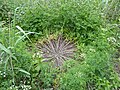 Clump of Oenanthe crocata


