Lilium candidum: Difference between revisions
CSV import |
CSV import |
||
| Line 25: | Line 25: | ||
{{Flora-stub}} | {{Flora-stub}} | ||
{{Medicine-stub}} | {{Medicine-stub}} | ||
<gallery> | |||
File:Northern_Italian_School_-_The_Madonna_and_Child_with_Saint_Nicholas_of_Tolentino_and_Saint_Anthony_of_Padua_-_NG3094_-_National_Gallery.jpg|The Madonna and Child with Saint Nicholas of Tolentino and Saint Anthony of Padua | |||
File:Lilium_candidum_MHNT.BOT.2011.18.27.jpg|Lilium candidum specimen | |||
File:Shoshan-Zachi-Evenor-6975.jpg|Lilium candidum | |||
File:Lilium_candidum_1.jpg|Lilium candidum | |||
</gallery> | |||
Latest revision as of 04:58, 18 February 2025
Lilium candidum, also known as the Madonna Lily, is a plant species in the Liliaceae. It is native to the Balkans and West Asia. The plant is a bulbous perennial with large, fragrant, and typically white flowers.
Description[edit]
The Lilium candidum grows up to 1.2 meters high and forms bulbs at the ground level. The leaves are lanceolate, and the flowers are trumpet-shaped, white, and strongly scented. The plant blooms in late spring to early summer.
Cultivation[edit]
Lilium candidum is cultivated for its flowers, which are used in floristry and perfumery. The plant prefers well-drained soil and full sun to partial shade. It is propagated by bulb division or from seed.
Symbolism[edit]
The Lilium candidum has been associated with purity and is often used in religious ceremonies. In Christian art, it is frequently depicted in association with the Virgin Mary.
Medicinal use[edit]
In traditional medicine, Lilium candidum has been used for its healing properties. The bulb is used in the treatment of ulcers and burns.
Conservation[edit]
The Lilium candidum is not currently considered threatened, but habitat loss and over-collection for the flower trade have led to a decline in some populations.
References[edit]
<references />

This flora-related article is a stub. You can help WikiMD by expanding it.

-
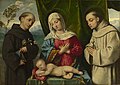 The Madonna and Child with Saint Nicholas of Tolentino and Saint Anthony of Padua
 -
 Lilium candidum specimen
 -
 Lilium candidum
 -
 Lilium candidum


