Ornithine transcarbamylase: Difference between revisions
CSV import Tags: mobile edit mobile web edit |
CSV import |
||
| Line 28: | Line 28: | ||
[[Category:Metabolic disorders]] | [[Category:Metabolic disorders]] | ||
{{enzyme-stub}} | {{enzyme-stub}} | ||
<gallery> | |||
File:OTC_reaction.png|Ornithine transcarbamylase reaction | |||
File:Binding_Motifs_of_Ornithine_Transcarbamylase.png|Binding motifs of Ornithine transcarbamylase | |||
File:Carbamoyl_Phosphate_Binding_of_Ornithine_Transcarbamylase.png|Carbamoyl phosphate binding of Ornithine transcarbamylase | |||
File:OTC_structure.png|Ornithine transcarbamylase structure | |||
</gallery> | |||
Latest revision as of 04:56, 18 February 2025
Ornithine transcarbamylase (OTC) is an enzyme that plays a crucial role in the urea cycle, a process that is responsible for the detoxification of ammonia in the body. OTC is the second enzyme in the urea cycle and catalyzes the reaction between carbamoyl phosphate and ornithine to form citrulline and phosphate.
Structure[edit]
OTC is a trimeric enzyme located in the mitochondria. Each subunit of the enzyme is composed of approximately 300 amino acids. The active site of the enzyme, where the reaction takes place, is located in the cleft between two domains of the enzyme.
Function[edit]
The primary function of OTC is to catalyze the reaction between carbamoyl phosphate and ornithine to form citrulline and phosphate. This reaction is a key step in the urea cycle, which is the primary pathway for the removal of toxic ammonia from the body.
Clinical significance[edit]
Deficiency in OTC is the most common cause of urea cycle disorders. This deficiency can lead to an accumulation of ammonia in the body, which can cause a variety of symptoms including vomiting, lethargy, and in severe cases, coma or death. Treatment for OTC deficiency typically involves a low-protein diet and medications to help remove ammonia from the body.
See also[edit]
References[edit]
<references group="" responsive="1"></references>

-
 Ornithine transcarbamylase reaction
 -
 Binding motifs of Ornithine transcarbamylase
 -
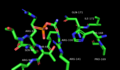 Carbamoyl phosphate binding of Ornithine transcarbamylase
 -
 Ornithine transcarbamylase structure


