Araucaria araucana: Difference between revisions
CSV import |
No edit summary |
||
| (3 intermediate revisions by the same user not shown) | |||
| Line 1: | Line 1: | ||
{{Short description|Species of tree native to central and southern Chile and western Argentina}} | |||
'''Antimony trifluoride''' is a chemical compound with the formula SbF<sub>3</sub>. It is a white crystalline solid that is used as a reagent in various chemical reactions and processes. | |||
== | ==Structure and Properties== | ||
Antimony trifluoride is composed of one antimony (Sb) atom and three fluorine (F) atoms. The compound forms a trigonal pyramidal shape, which is typical for compounds with a central atom surrounded by three ligands and a lone pair of electrons. This geometry is due to the [[VSEPR theory|valence shell electron pair repulsion (VSEPR) theory]]. | |||
The compound has a high melting point of 292 °C and a boiling point of 376 °C. It is highly soluble in water, forming a solution that is acidic due to the formation of hydrofluoric acid (HF). | |||
The | |||
== | ==Preparation== | ||
Antimony trifluoride can be prepared by the reaction of antimony trioxide (Sb<sub>2</sub>O<sub>3</sub>) with hydrofluoric acid (HF): | |||
: Sb<sub>2</sub>O<sub>3</sub> + 6 HF _ 2 SbF<sub>3</sub> + 3 H<sub>2</sub>O | |||
This reaction involves the replacement of oxygen atoms in antimony trioxide with fluorine atoms from hydrofluoric acid. | |||
[[Category:Trees]] | ==Applications== | ||
[[Category: | Antimony trifluoride is used in the production of [[fluorine]]-containing compounds. It acts as a fluorinating agent, meaning it can introduce fluorine atoms into other molecules. This property is useful in organic synthesis and in the preparation of other antimony compounds. | ||
In the glass and ceramics industry, antimony trifluoride is used as a flux to lower the melting point of raw materials, facilitating the formation of glass and ceramic products. | |||
==Safety and Handling== | |||
Antimony trifluoride is corrosive and can cause burns upon contact with skin or eyes. It should be handled with care, using appropriate personal protective equipment such as gloves and goggles. Inhalation of its dust or fumes should be avoided, as it can cause respiratory irritation. | |||
== Gallery == | |||
<gallery> | |||
File:Araucaria_en_Parque_Nacional_Conguillio.jpg|Araucaria araucana | |||
File:Zweig_der_Andentannne.JPG|Araucaria araucana | |||
File:A_young_Araucaria_araucana.jpg|Araucaria araucana | |||
File:Araucana_ubicacion.jpg|Araucaria araucana | |||
File:Piñones_de_araucaria_cocinados.jpg|Araucaria araucana | |||
File:Monkey_puzzle_tree_at_Salesforce_Park.jpg|Araucaria araucana | |||
File:Noche_estrellada_sobre_una_araucaria.jpg|Araucaria araucana | |||
File:Araucaria_araucana_playa.jpg|Araucaria araucana | |||
File:Conguillio_National_Park.jpg|Araucaria araucana | |||
File:Araucaria_araucana_cones.jpg|Araucaria araucana | |||
File:Araucaria_araucana0.jpg|Araucaria araucana | |||
File:Araucaria_araucana2.jpg|Araucaria araucana | |||
</gallery> | |||
==Related pages== | |||
* [[Antimony pentafluoride]] | |||
* [[Hydrofluoric acid]] | |||
* [[Fluorine]] | |||
* [[Antimony]] | |||
[[Category:Araucaria|araucana]] | |||
[[Category:Trees of Chile]] | |||
[[Category:Trees of Argentina]] | |||
[[Category:Endangered plants]] | [[Category:Endangered plants]] | ||
Latest revision as of 21:26, 18 February 2025
Species of tree native to central and southern Chile and western Argentina
Antimony trifluoride is a chemical compound with the formula SbF3. It is a white crystalline solid that is used as a reagent in various chemical reactions and processes.
Structure and Properties[edit]
Antimony trifluoride is composed of one antimony (Sb) atom and three fluorine (F) atoms. The compound forms a trigonal pyramidal shape, which is typical for compounds with a central atom surrounded by three ligands and a lone pair of electrons. This geometry is due to the valence shell electron pair repulsion (VSEPR) theory.
The compound has a high melting point of 292 °C and a boiling point of 376 °C. It is highly soluble in water, forming a solution that is acidic due to the formation of hydrofluoric acid (HF).
Preparation[edit]
Antimony trifluoride can be prepared by the reaction of antimony trioxide (Sb2O3) with hydrofluoric acid (HF):
- Sb2O3 + 6 HF _ 2 SbF3 + 3 H2O
This reaction involves the replacement of oxygen atoms in antimony trioxide with fluorine atoms from hydrofluoric acid.
Applications[edit]
Antimony trifluoride is used in the production of fluorine-containing compounds. It acts as a fluorinating agent, meaning it can introduce fluorine atoms into other molecules. This property is useful in organic synthesis and in the preparation of other antimony compounds.
In the glass and ceramics industry, antimony trifluoride is used as a flux to lower the melting point of raw materials, facilitating the formation of glass and ceramic products.
Safety and Handling[edit]
Antimony trifluoride is corrosive and can cause burns upon contact with skin or eyes. It should be handled with care, using appropriate personal protective equipment such as gloves and goggles. Inhalation of its dust or fumes should be avoided, as it can cause respiratory irritation.
Gallery[edit]
-
 Araucaria araucana
 -
 Araucaria araucana
 -
 Araucaria araucana
 -
 Araucaria araucana
 -
 Araucaria araucana
 -
 Araucaria araucana
 -
 Araucaria araucana
 -
 Araucaria araucana
 -
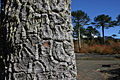 Araucaria araucana
 -
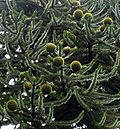 Araucaria araucana
 -
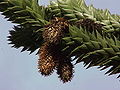 Araucaria araucana
 -
 Araucaria araucana


