Revenge: Difference between revisions
CSV import |
CSV import |
||
| Line 31: | Line 31: | ||
{{Psychology-stub}} | {{Psychology-stub}} | ||
{{Social-issues-stub}} | {{Social-issues-stub}} | ||
<gallery> | |||
File:Peinture_Palais_de_Justice_de_Toulouse.jpg|Peinture Palais de Justice de Toulouse | |||
File:DVinfernoMegaeraTisifphoneAlecto_m.jpg|DVinferno Megaera Tisifphone Alecto | |||
File:Prince_Hamlet_kill_King_Claudius,_in_Shakespeare's_Hamlet.jpg|Prince Hamlet kill King Claudius, in Shakespeare's Hamlet | |||
File:Notification_on_21_October_1941.jpg|Notification on 21 October 1941 | |||
File:Konishi_Hirosada_-_Igagoe_buyuden_-_Walters_95712.jpg|Konishi Hirosada - Igagoe buyuden - Walters 95712 | |||
</gallery> | |||
Latest revision as of 21:06, 23 February 2025
Revenge is a form of justice usually assumed to be enacted in the absence of the norms of formal law and jurisprudence. Often, it is the act of inflicting harm or damage on someone in response to a wrong suffered at their hands. This behavior is a fundamental element of the human ethical code, and various societies have differing views on the appropriateness of revenge as a response to perceived wrongs.
Etymology[edit]
The term "revenge" comes from the Old French word revenger, and the Latin word revindicare, both of which mean "to take back" or "to reclaim".
Historical Context[edit]
Throughout history, the concept of revenge has been prevalent in numerous cultures and societies. In ancient Roman law, the principle of Lex Talionis ("an eye for an eye") was a recognized form of punishment. Similarly, in the Hammurabi's Code, one of the oldest legal codes, revenge was legally sanctioned.
Psychology of Revenge[edit]
From a psychological perspective, individuals might seek revenge to restore balance or justice to a situation they perceive as unfair. Revenge can also serve as a form of deterrence to prevent future harm. However, research suggests that revenge often leads to a cycle of retaliation, rather than resolution, and can result in negative psychological effects such as increased anger and anxiety.
Revenge in Literature and Media[edit]
Revenge has been a common theme in literature and media. From the ancient Greek tragedies, such as Oresteia, to modern films and television series, the concept of revenge is often explored to highlight the moral and ethical dilemmas associated with it.
Criticism and Controversy[edit]
While some view revenge as a form of justice, others argue that it perpetuates a cycle of violence and does not lead to resolution or peace. Critics of revenge often advocate for forgiveness and reconciliation as healthier and more productive responses to harm or injustice.
See Also[edit]

This justice-related article is a stub. You can help WikiMD by expanding it.

This article is a psychology-related stub. You can help WikiMD by expanding it!
This social-issues related article is a stub. You can help WikiMD by expanding it.
-
 Peinture Palais de Justice de Toulouse
 -
 DVinferno Megaera Tisifphone Alecto
 -
 Prince Hamlet kill King Claudius, in Shakespeare's Hamlet
 -
 Notification on 21 October 1941
 -
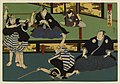 Konishi Hirosada - Igagoe buyuden - Walters 95712


