Surface runoff: Difference between revisions
CSV import |
CSV import |
||
| Line 34: | Line 34: | ||
{{Hydrology-stub}} | {{Hydrology-stub}} | ||
<gallery> | |||
File:Runoff.jpg|Surface runoff | |||
File:Runoffrazorback.jpg|Surface runoff | |||
File:Runoff_and_filtersoxx.ogv|Surface runoff | |||
File:Stormwater_Diagram.svg|Surface runoff | |||
File:View_of_urban_runoff_discharging_to_coastal_waters.jpg|Surface runoff | |||
File:Fascine49.jpg|Surface runoff | |||
File:Wassererosion_Acker.jpg|Surface runoff | |||
File:Runoff_of_soil_&_fertilizer.jpg|Surface runoff | |||
File:North-Bend-Uplands-Runoff-pond-3942.jpg|Surface runoff | |||
</gallery> | |||
Latest revision as of 12:04, 18 February 2025
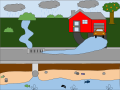
Surface runoff is the flow of water that occurs when excess stormwater, meltwater, or other sources flows over the Earth's surface. This might occur because soil is saturated to full capacity, because rain arrives more quickly than soil can absorb it, or because impervious areas (roofs and pavement) send their runoff to surrounding soil that cannot absorb all of it.
Overview[edit]
Surface runoff is a major component of the water cycle. It is the primary agent of soil erosion by water. The land area producing runoff that drains to a common point is called a drainage basin. When runoff flows along the ground, it can pick up soil contaminants such as petroleum, pesticides, or fertilizers that become discharge or nonpoint source pollution.
Factors influencing runoff[edit]
Several factors affect the amount of surface runoff from a drainage basin, including rainfall, soil type, vegetation, and the slope of the land.
Rainfall[edit]
The amount and intensity of rainfall are the primary factors that determine the amount of surface runoff. The greater the intensity and duration of the rainfall, the greater the amount of runoff.
Soil type[edit]
Different types of soil have different infiltration rates. Clay soils have a low infiltration rate and produce more surface runoff than sandy soils, which have high infiltration rates.
Vegetation[edit]
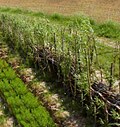
Vegetation can affect surface runoff by intercepting rain and allowing more time for it to infiltrate the soil. Vegetation can also create a physical barrier, slowing the flow of runoff and allowing more time for it to infiltrate.
Slope of the land[edit]
The slope of the land can greatly affect the amount of surface runoff. Steeper slopes are more likely to result in runoff because water will flow downhill rather than infiltrating the soil.
Effects of surface runoff[edit]
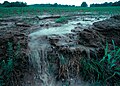
Surface runoff can have several effects on the environment, both positive and negative. It can lead to soil erosion, which can result in the loss of fertile topsoil and the alteration of habitats. It can also lead to water pollution if it picks up pollutants from the ground surface.
See also[edit]

-
 Surface runoff
 -
 Surface runoff
 -
 Surface runoff
 -
 Surface runoff
 -
 Surface runoff
 -
 Surface runoff
 -
 Surface runoff
 -
 Surface runoff
 -
 Surface runoff


