Polyphenism: Difference between revisions
CSV import Tags: mobile edit mobile web edit |
CSV import |
||
| Line 30: | Line 30: | ||
[[Category:Evolution]] | [[Category:Evolution]] | ||
{{biology-stub}} | {{biology-stub}} | ||
<gallery> | |||
File:Biston_betularia.png|Polyphenism | |||
File:Closeup_on_honeypot_ants_(Myrmecocystus_mimicus)_at_Oakland_Zoo.jpg|Polyphenism | |||
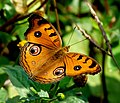
File:Junonia_almana_WSF_by_kadavoor.JPG|Polyphenism | |||
File:Junonia_almana_by_kadavoor.JPG|Polyphenism | |||
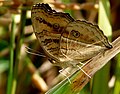
File:Junonia_almana_WSF_UN_by_kadavoor.JPG|Polyphenism | |||
File:Junonia_almana_DSF_by_kadavoor.JPG|Polyphenism | |||
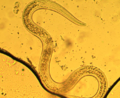
File:Third_stage_Phasmarhabditis_hermaphrodita.png|Polyphenism | |||
</gallery> | |||
Latest revision as of 11:35, 18 February 2025
Polyphenism is a phenomenon in the field of biology where an organism can develop into one of several distinct phenotypes depending on environmental conditions. This is a form of phenotypic plasticity, differing from genetic polymorphism where the phenotype is determined by genetic makeup and not influenced by the environment.
Overview[edit]
Polyphenism is a strategy used by many organisms to maximize their fitness in variable environments. It is a non-heritable form of variation as the changes in phenotype are not due to changes in the organism's DNA but are triggered by environmental cues.
Examples[edit]
One of the most well-known examples of polyphenism is found in social insects, such as ants, bees, and termites, where individuals develop into different castes (such as workers, soldiers, and reproductive individuals) depending on environmental cues.
Another example is the butterfly Biston betularia, also known as the peppered moth, which can develop into either a light or dark form depending on the level of industrial pollution in its environment.
Mechanisms[edit]
The mechanisms underlying polyphenism are complex and involve the interaction of genetic, epigenetic, and environmental factors. The environmental cues that trigger polyphenism can include temperature, diet, population density, and day length.
Evolutionary implications[edit]
Polyphenism has significant implications for evolution. It allows organisms to adapt to changing environments without the need for genetic change, providing a form of 'bet-hedging' against environmental uncertainty.
See also[edit]

-
 Polyphenism
 -
 Polyphenism
 -
 Polyphenism
 -
 Polyphenism
 -
 Polyphenism
 -
 Polyphenism
 -
 Polyphenism

_at_Oakland_Zoo.jpg)


