Mesa: Difference between revisions
CSV import |
CSV import |
||
| Line 27: | Line 27: | ||
[[Category:Landforms]] | [[Category:Landforms]] | ||
{{geology-stub}} | {{geology-stub}} | ||
== Mesa == | |||
<gallery> | |||
File:Mount_Conner_-_panoramio.jpg|Mount Conner | |||
File:Over_Monument_Valley,_Navajo_Nation.jpg|Monument Valley, Navajo Nation | |||
File:Cockburn_Range.jpg|Cockburn Range | |||
File:HarQatum.jpg|Har Qatum | |||
File:Amadiya_-_panorama.jpg|Amadiya Panorama | |||
File:Ingleborough_from_Little_Ingleborough_-_geograph.org.uk_-_548604.jpg|Ingleborough from Little Ingleborough | |||
File:Mesa_in_Colorado.jpg|Mesa in Colorado | |||
File:PIA21585_-_A_Mesa_in_Noctis_Labyrinthus.jpg|A Mesa in Noctis Labyrinthus | |||
</gallery> | |||
Latest revision as of 21:14, 23 February 2025
Mesa is a term used in geology to describe a land formation that is characterized by a flat-topped elevation with steep sides. The term originates from the Spanish word for table, due to the flat surface on top that resembles a table. Mesas are typically found in arid and semi-arid regions, such as the American Southwest, where erosion processes have shaped the landscape over millions of years.
Formation[edit]
Mesas are formed through a process of erosion and weathering. Over time, wind and water erode the softer rock layers, leaving behind the harder, more resistant layers. This process can take millions of years, and the resulting landform is a mesa. The top layer of a mesa is often a hard caprock that protects the softer layers below from further erosion.
Examples[edit]
There are many notable examples of mesas around the world. In the United States, the Colorado Plateau is home to many mesas, including the famous Monument Valley. Other examples include the Deccan Plateau in India and the Kalahari Desert in Africa.
Ecology[edit]
The ecology of mesas can vary greatly depending on the region. In the American Southwest, mesas are often home to a variety of desert-adapted plants and animals. The flat tops of mesas can support a different ecosystem than the surrounding lowlands, often hosting grasslands or forests.
In Culture[edit]
Mesas have played a significant role in human culture, particularly in the American Southwest. The Pueblo people built their homes on the tops of mesas for defensive purposes. Mesas also feature prominently in many Native American myths and legends.
See Also[edit]

Mesa[edit]
-
 Mount Conner
 -
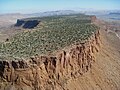 Monument Valley, Navajo Nation
 -
 Cockburn Range
 -
 Har Qatum
 -
 Amadiya Panorama
 -
 Ingleborough from Little Ingleborough
 -
 Mesa in Colorado
 -
 A Mesa in Noctis Labyrinthus


