Pyruvate dehydrogenase: Difference between revisions
CSV import |
CSV import |
||
| Line 24: | Line 24: | ||
[[Category:Metabolism]] | [[Category:Metabolism]] | ||
{{enzyme-stub}} | {{enzyme-stub}} | ||
== Pyruvate_dehydrogenase == | |||
<gallery> | |||
File:PDwhole1.jpg|PDwhole1 | |||
File:PyruvateDehyRxn.png|PyruvateDehyRxn | |||
File:PyruvDehydMech.png|PyruvDehydMech | |||
File:Pyruvate_dehydrogenase_E1_subunit_of_E._coli_(2000_pixels).png|Pyruvate dehydrogenase E1 subunit of E. coli | |||
File:PDActiveSite2.jpg|PDActiveSite2 | |||
File:1400x1048_pdh_regulation.png|1400x1048 pdh regulation | |||
</gallery> | |||
Latest revision as of 00:53, 27 February 2025
Pyruvate dehydrogenase (PDH) is a enzyme complex that plays a key role in the metabolic pathway known as the citric acid cycle, or Krebs cycle. This complex is responsible for the decarboxylation of pyruvate, a process that converts pyruvate into acetyl-CoA, a critical molecule in metabolism.
Structure[edit]
The PDH complex is composed of multiple copies of three enzymes: E1 (pyruvate dehydrogenase (lipoamide), E2 (dihydrolipoyl transacetylase), and E3 (dihydrolipoyl dehydrogenase). These enzymes work together to catalyze the conversion of pyruvate to acetyl-CoA.
Function[edit]
The primary function of the PDH complex is to convert pyruvate, a product of glycolysis, into acetyl-CoA, which can then enter the citric acid cycle. This process is critical for the production of adenosine triphosphate (ATP), the main energy currency of the cell.
Regulation[edit]
The activity of the PDH complex is tightly regulated by a number of factors, including the availability of substrates and the energy needs of the cell. The complex is also subject to regulation by phosphorylation and dephosphorylation, processes that are controlled by specific kinase and phosphatase enzymes.
Clinical significance[edit]
Defects in the PDH complex can lead to a number of metabolic disorders, including pyruvate dehydrogenase deficiency. This condition is characterized by a buildup of lactic acid in the body and can lead to neurological problems and developmental delays.
See also[edit]
References[edit]
<references />

Pyruvate_dehydrogenase[edit]
-
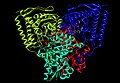 PDwhole1
 -
 PyruvateDehyRxn
 -
 PyruvDehydMech
 -
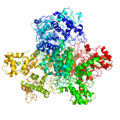 Pyruvate dehydrogenase E1 subunit of E. coli
 -
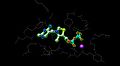 PDActiveSite2
 -
 1400x1048 pdh regulation


.png)


