Decriminalised parking enforcement: Difference between revisions
CSV import Tags: mobile edit mobile web edit |
CSV import |
||
| Line 28: | Line 28: | ||
[[Category:Law enforcement in the United Kingdom]] | [[Category:Law enforcement in the United Kingdom]] | ||
{{law-stub}} | {{law-stub}} | ||
<gallery> | |||
File:Traffic_warden_enforcing_in_Camden.jpg|Traffic warden enforcing in Camden | |||
File:MINI_loaded_onto_tow_truck.jpg|MINI loaded onto tow truck | |||
File:Hammersmith_&_Fulham_roadside_parking_restriction_notice.jpg|Hammersmith & Fulham roadside parking restriction notice | |||
</gallery> | |||
Latest revision as of 04:14, 18 February 2025
Decriminalised Parking Enforcement (DPE) is a system of parking management that allows local authorities to enforce parking restrictions in their area, rather than the police. This system was introduced in the UK under the Road Traffic Act 1991 and has since been adopted in many other countries.
History[edit]
Decriminalised Parking Enforcement was first introduced in the UK in 1991, with the passing of the Road Traffic Act. This act gave local authorities the power to enforce parking restrictions in their area, rather than relying on the police. The aim of this was to free up police resources and allow local authorities to better manage parking in their area.
Implementation[edit]
Under DPE, local authorities are responsible for enforcing parking restrictions. This includes issuing Penalty Charge Notices (PCNs) to vehicles that are parked in violation of the restrictions. The local authority is also responsible for collecting the fines from these PCNs.
The enforcement of parking restrictions is usually carried out by Civil Enforcement Officers (CEOs), who are employed by the local authority. CEOs have the power to issue PCNs and can also have vehicles towed away if they are causing an obstruction or are parked in a dangerous manner.
Benefits[edit]
There are several benefits to the DPE system. Firstly, it allows local authorities to better manage parking in their area. This can help to reduce congestion and improve traffic flow. Secondly, it frees up police resources, allowing them to focus on more serious crimes. Finally, the revenue generated from PCNs can be used to fund local transport projects.
Criticisms[edit]
Despite its benefits, the DPE system has also faced criticism. Some argue that it gives too much power to local authorities and can lead to overzealous enforcement. Others argue that the fines from PCNs are too high and can disproportionately affect low-income drivers.
See also[edit]

-
 Traffic warden enforcing in Camden
 -
 MINI loaded onto tow truck
 -
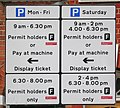 Hammersmith & Fulham roadside parking restriction notice


