Snake wine: Difference between revisions
CSV import |
CSV import |
||
| Line 32: | Line 32: | ||
{{Alcohol-stub}} | {{Alcohol-stub}} | ||
{{food-stub}} | {{food-stub}} | ||
<gallery> | |||
File:Snakewine.jpg|Snake wine | |||
File:Ruou_thuoc_1.jpg|Snake wine | |||
File:Scorpion_wine.jpg|Scorpion wine | |||
</gallery> | |||
Latest revision as of 01:32, 18 February 2025
Snake wine is a traditional alcoholic beverage consumed in several Asian cultures, including China, Vietnam, and Laos. It is made by infusing whole snakes in rice wine or grain alcohol. The resulting drink is believed to have medicinal properties, particularly for conditions such as rheumatism and lumbago.
History[edit]
The practice of making snake wine dates back to the Western Zhou dynasty in China, where it was used as a curative for various ailments. The tradition spread to other parts of Asia over the centuries, with different regions developing their own variations of the beverage.
Production[edit]
Snake wine is produced by placing a live snake in a jar of rice wine or grain alcohol. The snake is left to drown and ferment in the alcohol for several months. Some producers also add herbs and other ingredients to the mixture to enhance its flavor and purported medicinal properties. The snake's venom is denatured by the alcohol, making it safe to drink.
Consumption[edit]
Snake wine is typically consumed in small quantities as a digestif. It is often served in tiny cups or shot glasses, and is usually consumed neat, without any mixers or ice. In some cultures, it is customary to eat the snake after drinking the wine.
Health effects[edit]
While snake wine is believed to have medicinal properties, there is limited scientific evidence to support these claims. Some studies suggest that snake wine may have anti-inflammatory and analgesic effects, but more research is needed to confirm these findings. There are also concerns about the potential for snake wine to transmit diseases, such as salmonella.
Legal status[edit]
The production and sale of snake wine is illegal in many countries due to animal cruelty laws and regulations on the trade of endangered species. However, it remains popular in parts of Asia where these laws are not strictly enforced.
See also[edit]


-
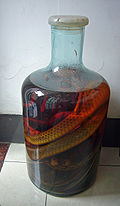 Snake wine
 -
 Snake wine
 -
 Scorpion wine


