Thatching: Difference between revisions
CSV import |
CSV import |
||
| Line 28: | Line 28: | ||
{{building-material-stub}} | {{building-material-stub}} | ||
{{food-stub}} | {{food-stub}} | ||
<gallery> | |||
File:pub.williams.arp.750pix.jpg|Thatching | |||
File:87_-_Machu_Picchu_-_Juin_2009.jpg|Thatching | |||
File:PrayerAtBesakih.jpg|Thatching | |||
File:Darß.6.JPG|Thatching | |||
File:Born.Zingst.1.JPG|Thatching | |||
File:Thatched_cottage_in_the_sand_dunes_by_Denmark.jpg|Thatching | |||
File:Ireland_Victor_Grigas_2011-29.jpg|Thatching | |||
File:Cahire.JPG|Thatching | |||
File:Thatched_roofs_in_Kerene.jpg|Thatching | |||
File:Efteling_Entrance.jpg|Thatching | |||
File:Ogi_Shirakawa06n3200.jpg|Thatching | |||
File:Korea_south_traditional_house.jpg|Thatching | |||
</gallery> | |||
Latest revision as of 11:40, 18 February 2025
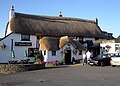
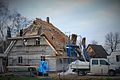
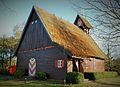
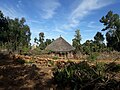
Thatching is a traditional method of building a roof with dry vegetation such as straw, water reed, sedge, rushes, or heather. It is a craft that has been practiced for thousands of years, and it continues to be used in certain parts of the world today.
History[edit]
Thatching has been used as a roofing material since the Neolithic period. The oldest thatched roofs discovered by archaeologists date back to this era. Thatching was a common practice in both rural and urban areas until the 19th century, when more modern materials began to replace it.
Materials[edit]
The materials used for thatching vary depending on the region. In the UK, for example, water reed and wheat straw are commonly used. In other parts of the world, materials such as palm leaves, bamboo, and even animal hair can be used. The choice of material can affect the appearance, longevity, and fire resistance of the roof.
Techniques[edit]
There are several different techniques used in thatching. The most common method is known as "long straw" thatching, which involves the use of whole straw stalks. Another method is "combed wheat reed" thatching, which uses the straw part of the wheat plant. There is also "water reed" thatching, which uses the tall, woody stems of the water reed plant.
Advantages and Disadvantages[edit]
Thatched roofs have several advantages. They provide excellent insulation, keeping buildings cool in summer and warm in winter. They are also environmentally friendly, as they are made from renewable resources. However, they also have some disadvantages. They can be expensive to install and maintain, and they are not as fire-resistant as other types of roofing.
Modern Thatching[edit]
In recent years, there has been a resurgence of interest in thatching. This is partly due to its environmental benefits, and partly due to a desire to preserve traditional crafts. Modern thatchers use both traditional and modern techniques to create roofs that are both beautiful and durable.
See Also[edit]
 | This architecture-related article is a stub. You can help Wikipedia by adding missing information. |
This building material related article is a stub.

-
 Thatching
 -
 Thatching
 -
 Thatching
 -
 Thatching
 -
 Thatching
 -
 Thatching
 -
 Thatching
 -
 Thatching
 -
 Thatching
 -
 Thatching
 -
 Thatching
 -
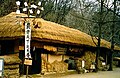 Thatching


